This article was updated on 18th March 2026
Google’s dominance in search is being challenged faster than most expected. AI-powered tools led by ChatGPT are driving measurable shifts in how people search, what they click, and whether they click at all. This post was originally published in July 2025 with six statistics. We have now expanded it to ten, updated all figures to reflect primary research from late 2025 and early 2026, and added a last-updated date.
Here are some stats showing just how quickly the adoption of AI tools like ChatGPT are driving a change in search behaviour and usage – and potentially undermining Google’s dominance.
1. Google drops below 90% share of the search engine market for first time
Google has always had the majority share of the search engine market, with over a 90% share. But in mid 2024, its share dropped below 90% for the first time. At the time of writing this post in July 2025, it has a 89.54% share of the market.
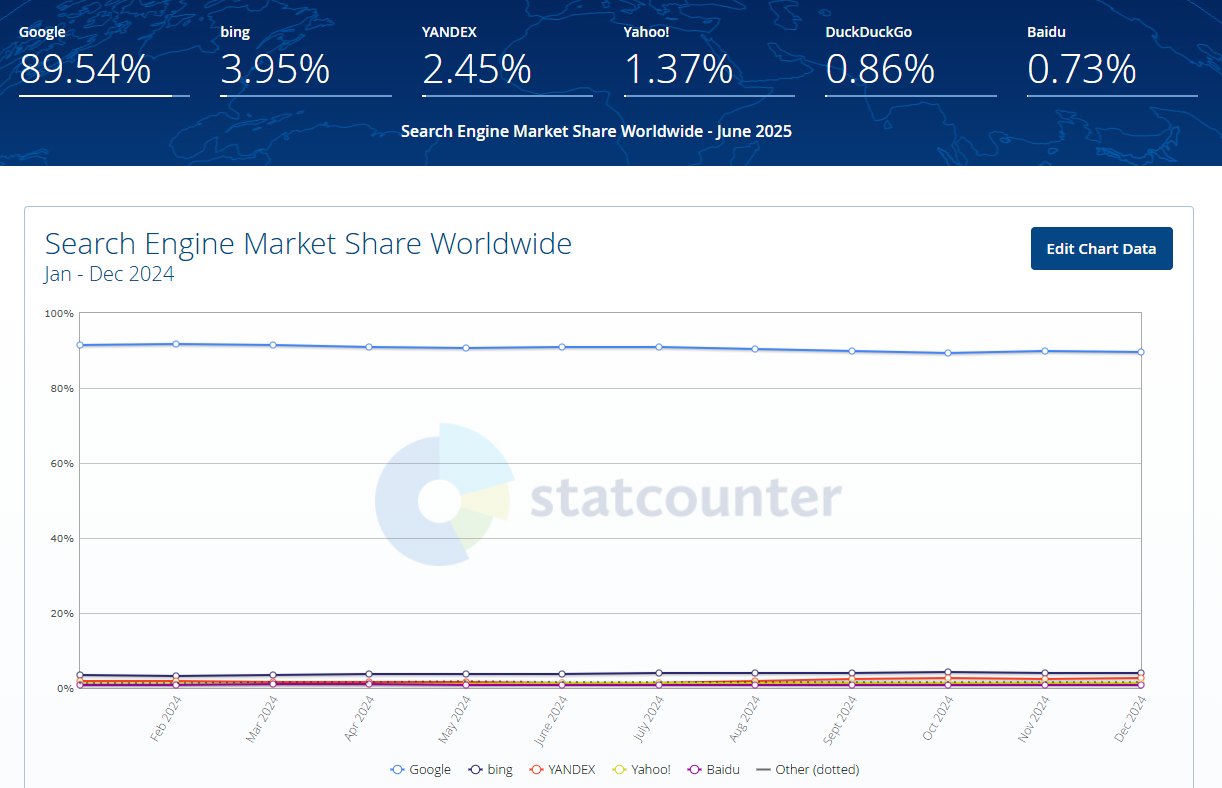
In a similar time period, Bing has increased its share from 3.32% in February to just under 4% in July 2025. Whilst this change might not seem significant, it’s interesting to think about when considering that OpenAI has a partnership with Bing and it uses Bing’s index to search the web inside ChatGPT.
2. Gartner predicts a 50% drop in organic search by 2028 due to AI search
Based on its research and surveys, Gartner believes that the ‘rapid adoption of GenAI in search engines will significantly disrupt CMOs’ ability to harness organic search to drive sales.’
Emily Weiss, Senior Principal Researcher in the Gartner Marketing Practice, added “Marketing leaders whose brands rely on SEO should consider allocating resources to testing other channels in order to diversify.”
3. Similarweb shows ChatGPT is now the 5th most visited website in the world
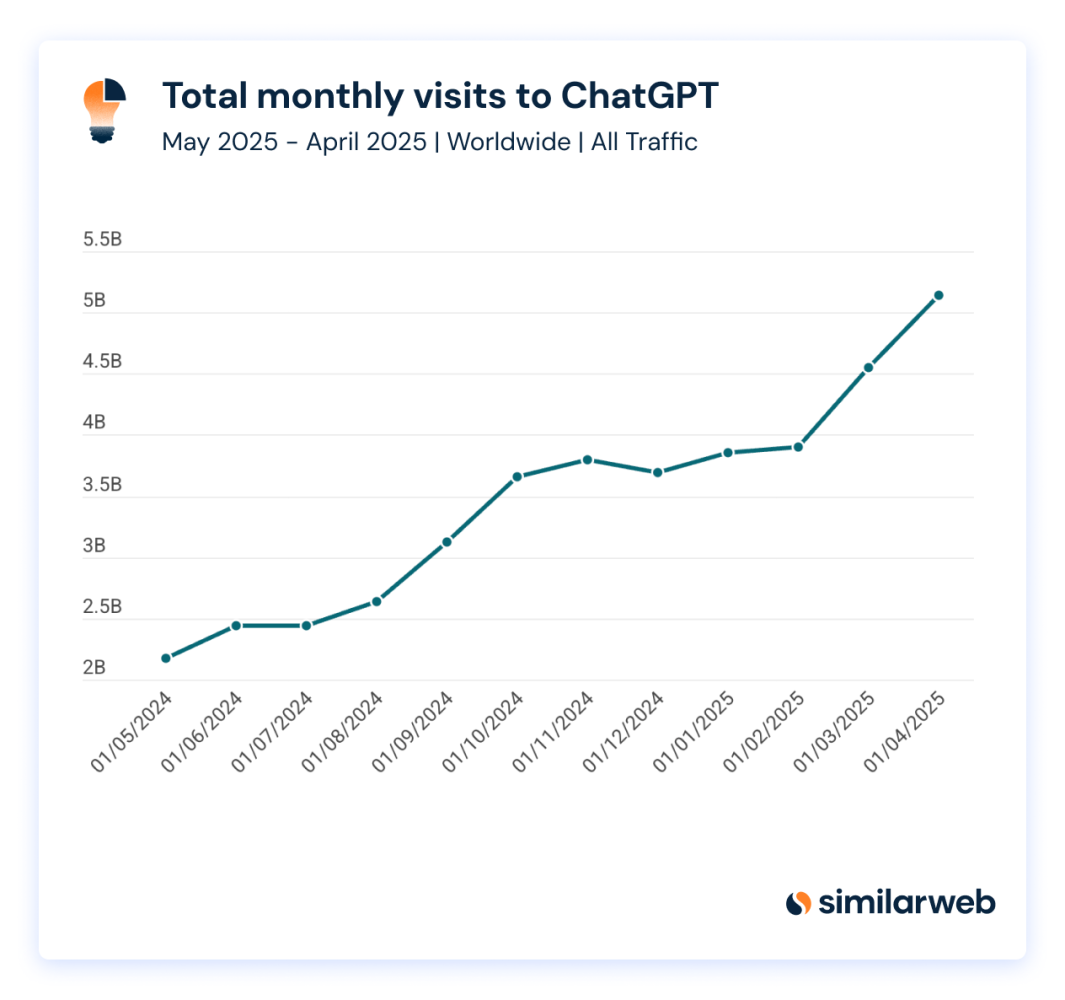
In April 2025 ChatGPT took over X to become the 5th most visited website in the world. Impressive by any measure, but even more so when you consider it wasn’t even 3 years old at this point.
And what’s just as impressive is the ongoing growth and just how quickly they are adopting new users.
4. AI Overviews now appear in around 25% of all Google searches
AI Overviews appear on approximately 25% of Google searches as of November 2025, up from around 4% in January 2025. In health and science categories the figure can reach 40% or higher, according to this research from Conductor.
5. Ahrefs confirms AI Overviews reduce clicks by 58% for the top-ranking page
Ahrefs’ study of 300,000 keywords (December 2025) found that AI Overviews correlate with a 58% lower click-through rate for the page ranking first. The effect is present even for pages that own the AI Overview citation — they see more impressions but fewer clicks per impression.
6. AI search traffic converts at significantly higher rates (but context matters)
Seer Interactive’s case study (October 2024 to April 2025, B2B software client): ChatGPT converted at 15.9%, Perplexity at 10.5%, Claude at 5%, Gemini at 3%, versus Google organic at 1.76%. ChatGPT users also viewed 2.3 pages per session versus 1.2 for organic. Ahrefs reported internally that AI traffic drove 12.1% of all signups from just 0.5% of visits — a 23x conversion rate advantage. Semrush’s broader July 2025 research found LLM visitors convert 4.4x better than organic on average. The effect is strongest for B2B and high-consideration purchases; it is weaker or neutral for impulse ecommerce.
7. Being cited in an AI Overview dramatically improves all search performance
Seer Interactive found that brands cited in AI Overviews earn 35% higher organic CTR and 91% higher paid CTR compared to brands that are not cited. The implication: the goal has shifted from ranking to being cited, with being cited unlocking compounding performance advantages across both organic and paid.
8. Referring domains are the single strongest predictor of AI citation
SE Ranking’s study of 129,000 domains found referring domains are the strongest predictor of ChatGPT citation. Sites with more than 350,000 referring domains average 8.4 citations per response. Domains active on Trustpilot, G2, and Capterra earn 3x more citations than those without profiles. This means link-building for traditional SEO and AI search visibility are largely the same investment.