Category: Generative Engine Optimisation

Explore FirstMotion's latest insights and company news.

Generative Engine Optimisation

How to choose a B2B SaaS GEO/AI SEO agency [with evaluation scorecard download]

A B2B software marketers guide to choosing a generative engine optimisation, LLMO or AI search agency/consultancy partner. Includes evaluation scorecard download.

AI assistants like ChatGPT, Perplexity and Google’s AI Overviews are reshaping how B2B software buyers discover and evaluate solutions. Traditional SEO agencies aren’t always built for this new reality. You need a partner that understands Generative Engine Optimisation (GEO) - and more importantly, understands B2B SaaS, complex buying journeys, and how AI assistants now influence decisions long before anyone reaches your website.

Here’s what to look for when choosing a GEO agency with strong B2B SaaS & Software credentials.

You can download our GEO/AI SEO agency evaluation scorecard here: Download [doc]

1. Proven results in generative visibility and a focus on revenue outcomes

Any agency can show you keyword rankings and traffic graphs. That’s not enough anymore.

Look for a partner that can show evidence of visibility in AI generated answers from ChatGPT and Perplexity to Google AI Overviews. Ask to see how they track prompts, citations, and competitor coverage using tools like Peec AI. Ask to understand their methodology, and how they are approaching the process of improving AI search performance.

2. A focus on revenue outcomes

But visibility isn’t the end goal. You want an agency that connects AI presence to real commercial outcomes: buyer influence earlier in the journey, more qualified leads and stronger pipeline.

AI search is still evolving and attribution sometimes difficult, but you need an agency with the right mindset and that speaks your language.

At FirstMotion, we believe AI search is changing the entire length of the B2B buyer journey - not just initial discovery. It's our goal to prove that AI search can be a revenue driver for B2B software brands, not just a visibility measure.

3. A deep understanding of how LLMs actually work

Generative Engine Optimisation is not just SEO with new keywords. You need a partner that understands:

  • How LLMs cite and reference content
  • The importance of structured data and clean formatting
  • The sources models trust (e.g. G2, Reddit, Gartner, community forums)
  • How prompts vary by buyer role and journey stage

GEO is about earning influence, not just publishing content. AI search is more technical than ever, and so an agency partner should have proven technology credentials.

LLMs are new and the world changing fast - so you can't expect a partner to always have answers. This is no different to SEO and algorithm changes. But you should expect them to always be learning, testing, sharing their insights, and have a clear B2B focused methodology for approaching the AI SEO landscape.

4. Fluency in B2B SaaS buyer behaviour

Generic content doesn’t win in AI search. The best GEO strategies are built around audience intelligence.

That means:

  • Mapping the decision-making unit, not just personas
  • Understanding long sales cycles and complex buying processes
  • Aligning prompts to buyer roles, not just funnel stages

Your agency should speak your language – ACVs, RFPs, compliance risks, enablement content, analyst briefings. Not just keywords and blog posts.

At FirstMotion, we're unique in having our own ContextualJourney™ AI search audience intelligence platform to help us deeply understand buyer behaviour as we shape AI SEO strategies and map/align prompts.

5. Strategic alignment with your marketing goals

AI search doesn’t sit in isolation. It feeds into brand, content, demand generation, ABM and revenue marketing.

The right agency won’t just deliver tasks. They’ll act as an extension of your team, helping you:

  • Prioritise the right prompts based on intent
  • Build content that supports both AI and human journeys
  • Make smart bets based on research and data
  • Translate visibility into buyer influence and pipeline

If they don't understand your goals as a B2B marketer, they can’t help you meet them.

6. Built for experimentation and rapid change

The AI search space is evolving every week. You need a partner who’s:

  • Testing LLM behaviour in real-time
  • Tracking changes to AI visibility across a large number of prompts
  • Monitoring shifts in prompt phrasing and source influence

At FirstMotion, we treat GEO like a living system, not a set-and-forget checklist. We maintain the largest up to date database of GEO/AI SEO research studies as well as carrying out our own visibility index reports.

7. Modern, AI-first delivery model (not the old agency playbook)

Most SEO agencies are built on bloated account teams, manual reporting, and recycled strategies.

FirstMotion is different. With our founder having previously built and sold a SEO agency in the pre-AI era, we're building FirstMotion differently, firmly believing that the traditional agency model is dead.

We’re AI first, lean by design, and powered by our proprietary ContextualJourney™ platform. That means:

  • No layers of account managers slowing you down
  • Leaner, faster delivery
  • A focus on consultancy and client empowerment
  • Real time insight, automation, and buyer contextual strategies

Our goal is to combine consultancy grade thinking with technology grade speed.

8. Transparent tracking and reporting

You can’t manage what you can’t measure. Your agency should:

  • Show you which prompts you’re visible for
  • Break down your inclusion in different LLMs
  • Track changes in citation sources and formats
  • Benchmark you against competitors
  • Iterate quickly

We use tools like Peec AI and integrate with your broader analytics stack to give full funnel visibility.

9. Proven track record by a B2B SEO leader

FirstMotion was founded by Alex Price, who previously built and sold one of the UK’s leading B2B SEO agencies. His agency led enterprise SEO strategies for brands like:

  • Amazon
  • Inmarsat
  • SparkCognition
  • Nexthink
  • Amplitude
  • Vertex
  • Qt
  • SuperAwesome
  • Codat
  • NetDocuments
  • Sitecore
  • Peak AI

FirstMotion's B2B software credentials run deep.

10. Ability to help with 'traditional SEO'

We're in a shift at the moment - Google is still the most used search engine, but AI usage and traffic is increasing, and expected to continue to do so.

So it might be important for you to have an agency or consultancy partner that can help with your 'traditional SEO' strategy too. A good AI focused search agency should have its roots in SEO, and therefore be able to assist with both - keeping your agency roster simple, reducing the number of partners you have to manage and making sure SEO and GEO are aligned - which makes a lot of sense given how they overlap in many areas.

Conclusion: AI SEO is a strategic capability

Choosing the right GEO agency or consultancy is one of the most important decisions a B2B SaaS brand will make over the next 12 months. It’s the difference between showing up in the next wave of AI-native buying journeys.

You can download our GEO/AI SEO agency evaluation scorecard here: Download [doc]

At FirstMotion, we help B2B software companies turn buyer understanding into prompt strategy, prompt strategy into AI visibility, and AI visibility into pipeline.

Alex Price

July 18, 2025

Generative Engine Optimisation

What's the role of a B2B website in a zero click world?

What role does a B2B website need to play in a world where much of the buyer journey is happening inside AI tools like ChatGPT, Claude or Perplexity?

In the old world of B2B marketing, your website was the main event. Buyers Googled their way to your homepage, clicked through carefully structured landing pages, filled out forms, and got nurtured through the funnel.

But that playbook is collapsing.

It seems we're heading for the zero click (or at least the 'very few click') era - a world where perhaps lots of the buyer journey takes place without a single visit to your site. Where AI assistants like ChatGPT, Perplexity, and Google’s AI Overviews act as the primary research layer. Where answers are synthesised and surfaced directly in the AI tools your buyers are already using.

So if your website isn’t the starting point anymore, what is it?

Maybe it's your final impression.

Your website is no longer the beginning – it’s the handshake

By the time someone reaches your homepage, they may already have:

  • Asked ChatGPT for a shortlist of solutions
  • Read reviews on G2 or Capterra
  • Compared features in Perplexity
  • Evaluated you through Reddit or LinkedIn threads
  • Checked analyst commentary in Gartner or Forrester

All or lots of this information may have been served up to them without ever having left the chat with their AI assistant of choice. It gets them everything they need and delivers it to them in one centralised location where they can continue to interrogate it, clarify things, ask for more follow information etc. It's clear that this is a much improved research experience for the buyer when comparted to the old world of opening lots of sites, adding them to a spreadsheet, manually taking notes and so on.

In other words: they’ve done their homework without you. Now they’re looking for a final confirmation. A spark of confidence. A moment of clarity. An emotional hook.

Your site now serves two audiences: humans & machines

In the AI-powered B2B software buyer journey, your website has a split role:

  • For AI assistants: provide clear, structured, citable content. That means:
    • Semantic markup (schema, FAQs, definitions)
    • Declarative answers (not marketing fluff)
    • Author pages, citations, source clarity
    • Explicit product details, integrations, and positioning
  • For humans: deliver a differentiated, memorable experience. That means:
    • Clear navigation and messaging hierarchy
    • Standout brand impact, creative and UX design
    • Memorable experience
    • Visual trust signals (logos, quotes, stats, awards)
    • Emotional resonance and storytelling

If you only focus on one audience, you’ll lose the other. You need both.

Creativity is no longer optional - it’s your edge

When every category starts to feel the same in AI answers, your brand becomes the differentiator.

If a buyer lands on your site after already seeing summaries of your competitors, your job is to break the pattern.

  • Surprise them with bold messaging
  • Use interaction, motion, and emotion
  • Tell stories, not just specs
  • Make it memorable enough to stick

This isn’t fluff - it’s conversion science for a new age of research and reference.

So what now? A creative renaissance for B2B websites?

As AI search continues to grow and a greater amount of the B2B buyer journey takes place without a website visit, perhaps it's time to refocus your website as mainly serving the last mile of the buyer journey.

But this shift isn’t something to fear. It’s an opportunity.

If the AI assistant handles the facts, your website can finally focus on what AI can’t do: make people feel something.

At FirstMotion, we think this could be the beginning of a creative renaissance in B2B SaaS website design. A chance to break free from the rinse-and-repeat grid of safe, samey websites. A powerful chance to stand out.

When the functional job of 'providing information' (whatever that might mean) is already handled by ChatGPT or Perplexity, your site can go beyond clarity. It can be bold. Emotional. Artful. A true expression of your brand’s personality, not just its product.

This doesn’t mean sacrificing usability - it means pairing substance with soul. Being clear and courageous. If buyers already have the facts, your job is to leave an impression they’ll remember.

The AI age doesn’t kill creativity. It demands it.

Your website’s moment isn’t gone - it might just come later in the journey. And when it comes, it had better hit hard.

Tom Batting

July 17, 2025

Generative Engine Optimisation

How are AI search tools like ChatGPT reshaping the B2B buyer journey?

Wondering how AI tools like ChatGPT are reshaping the B2B buyer journey for good? We explore the AI native B2B buyer journey.

The B2B software buyer journey has changed. And not just a little bit. Thanks to AI search tools like ChatGPT, Perplexity, Claude and Google AI Overviews, it’s being fundamentally rewritten.

For years, marketers optimised for traditional search engines by aligning content with keywords. But AI search doesn’t behave like Google. There are no search result pages with ten blue links, no fixed rankings, and no linear journey.

And that changes everything. Welcome to the new world of AI native B2B SaaS & software buyer journeys.

The emergence of AI search in B2B research

AI tools are being used across the B2B buying journey as buyer enablement co-pilots, answer engines, and recommendation engines.

  • Users are bypassing Google to ask ChatGPT directly for recommendations
  • Google’s own AI Overviews are pushing traditional organic listings further down the page
  • Models are citing trusted sources, not necessarily the brands themselves

In short, there are now entire buying journeys happening that brands have much reduced visibility of. This is the new B2B dark funnel.

At FirstMotion, we see AI tools as being inside the B2B decision making unit. They are part of the buying unit, providing guidance, counsel, advice and active assistance as B2B buyers navigate their buying journey.

How AI assistants shift behaviour at each journey stage

AI might not be always be changing what buyers search buyers search for, but it's certainly changing how they search.

Problem identification
Buyers are turning to AI assistants to articulate challenges, validate pain points, or explore peer experiences:

  • “As a CISO at a mid-sized fintech company expanding into the EU, what are the common third-party risk challenges I should be aware of going into 2025?”
  • “How do in-house legal teams at high-growth SaaS companies typically manage visibility and control over contract renewals across departments without relying on shared drives or email threads?”

Solution exploration
Buyers use LLMs to map the landscape of solutions based on their specific context:

  • “What tools are used by growth-stage cybersecurity companies to automate ongoing SaaS vendor risk assessments while maintaining ISO 27001 compliance?”
  • “Compare Ironclad, LinkSquares, ContractPodAi, and SpotDraft specifically for legal teams in B2B SaaS companies with 200–500 employees that need Google Workspace and Salesforce integrations.”

Requirements building
LLMs help buyers define the scope and specifics of what they actually need:

  • “What features should a legal team prioritise in CLM software if we’re aiming to automate fallback clauses, track negotiation workflows, and ensure version control across sales and procurement?”
  • “We’re preparing an RFP for an enterprise DAM platform – what technical requirements, integration capabilities, and user access controls should we specify for a distributed marketing team operating across three global regions?”

Supplier evaluation
Buyers are now getting multi-dimensional comparisons based on their role, goals and constraints:

  • “As the VP of Legal in a late-stage tech company preparing for IPO, which CLM platform is rated highest for rapid deployment, scalability, and audit readiness – LinkSquares, Ironclad, or ContractWorks?”
  • “What do in-house counsel teams in 500+ employee SaaS companies typically say in reviews about the quality of implementation support and ease of adoption when comparing Ironclad to SpotDraft?”

It's important to notice that these prompts are longer, more contextual, and more reflective of real decision making than 'SEO keywords' ever were.

Read more: What AI prompts should B2B software brands optimise for?

AI tools aren't just providing information

AI assistants like ChatGPT are no longer just search engines in disguise. They’re not simply surfacing content or summarising articles - they’re actively doing the work sometimes.

In B2B marketing, this shift is subtle but profound.

Buyers aren’t just asking for lists of tools or pros and cons anymore. They’re using AI to create the artefacts that drive purchase decisions:

  • Researching how other similar businesses might be solving similar problems
  • Creating business cases for investing in a new solution
  • Drafting full RFPs tailored to internal requirements
  • Building vendor comparison frameworks with weighted criteria
  • Generating scoring models for evaluating product demos
  • Creating checklists for compliance or technical due diligence
  • Drafting internal summaries for board or budget approval

This means the assistant isn’t just part of the research phase - it’s shaping the actual decision making process.

If your content, product positioning, and proof points aren’t being picked up, understood, and incorporated by these tools, you’re not just missing traffic - you’re missing influence at the most critical moment.

B2B marketers now need to think beyond visibility. You need to ask:
“Is my brand showing up in the outputs buyers are taking into meetings?”

That’s a very different game. And winning it starts with understanding buyer behaviour and ensuring your information is findable, credible, and structurally usable by AI.

Why audience intelligence is more important than ever

Because buyers are using AI assistants like humans - in plain English, in long form, with detail - your prompt strategy is only as strong as your understanding of the buyer.

At FirstMotion, we use our ContextualJourney™ technology platform to:

  • Map real companies and their buying units
  • Identify individual personas and their needs, pain points, triggers etc
  • Enrich the ICP & persona data with AI & various sources such as review data, analyst research
  • Align likely prompts across each buyer journey stage
  • Generate prompts that may be used across each stage of the buyer journey

Prompt strategy without buyer context is guesswork. We don’t do guesswork.

Implications for B2B content strategy

This shift in buyer behaviour, and the role AI tools are playing across the full length of the B2B buyer journey, demands a new B2B SEO/content strategy approach:

  • Answer full questions, not just keywords
  • Provide structured, scannable content that LLMs can parse
  • Focus on semantic depth over SEO fluff
  • Align all content with ICP, persona & buyer stage
  • Think about usable assets that can assist the buyer journey - checklists, templates, spreadsheets etc

If ChatGPT is building your buyer’s shortlist, your content needs to shape the answer.

Why visibility tracking is now critical

With AI search, you can’t just rely on Google Analytics to tell you what’s happening.

We use tools like Peec AI to:

  • Monitor how often your brand appears in AI answers
  • Track changes in inclusion over time
  • Compare against competitors
  • Spot which prompts are driving the most visibility
  • Understand the sources of influence and content that LLMs reference

Generative engine optimisation isn’t about a specific ranking position - it’s about the probability of being visible - and that's a big shift in mindset for lots of B2B marketers.

What B2B SaaS marketers need to do

To keep up with the shifting buyer journey, B2B software marketers should:

  • Map their ICPs, personas, and journey stages
  • Identify and map prompts at each stage
  • Audit prompt visibility using specialist tools
  • Create content aligned with buyer needs and language
  • Optimise for influence, not just presence
  • Monitor and iterate continuously

The AI search revolution isn’t coming. It’s already here.

B2B buyers are researching, evaluating, and shortlisting using AI assistants as their one source of truth and buyer enablement co-pilot - from 'first prompt' through to 'closed won'. If your strategy doesn’t adapt, your brand risks becoming invisible.

At FirstMotion, we help enterprise B2B SaaS & software brands navigate the shift from SEO to the new world of AI native B2B buyer journeys. Check out our recent post if you need help building your business case to invest in AI search.

Tom Batting

July 16, 2025

Generative Engine Optimisation

Account based marketing (ABM) in the age of AI search

We explore how account based marketing (ABM) and generative engine optimisation (GEO) might have more overlap than it seems.

Account based marketing (ABM) and generative engine optimisation (GEO) might feel like two different worlds - one rooted in outbound orchestration, the other in AI-powered inbound discovery. But maybe they are more alike than they seem.

Both are grounded in one principle: relevance to the right buyer, at the right moment.

As AI search tools like ChatGPT, Perplexity and Claude begin shaping B2B buying journeys earlier than ever, it’s time to rethink how ABM and GEO can work together - not in parallel, but in concert.

ABM and GEO share the same DNA

ABM is about going deep, not broad. You tailor your messaging, content, and channels to a defined set of target accounts - and within them, the key decision-makers and influencers.

Our enterprise B2B approach to AI search works the same way. But instead of targeting people with ads and outreach, you’re targeting the prompts those people are putting into AI assistants.

Done right, GEO becomes the passive twin of ABM - shaping buyer perceptions before your first outbound email is ever opened.

Your key accounts are using AI – you just can’t see it

Let’s say you’re targeting legal teams at mid sized SaaS companies as part of an ABM campaign for your CLM software.

You might run ads. You might push content. You might trigger outbound SDR sequences.

But what if the buyer journey started a week earlier - in a conversation with ChatGPT?

“What CLM tools are best for mid-sized SaaS companies with lean legal teams and basic Salesforce integration needs?”

If your brand shows up in the answer, you may already be winning the perception battle.

If it doesn’t, you’ve already lost ground and you’ll never see it in your attribution data.

This is the new B2B dark funnel - and it’s where GEO lives.

From account lists to prompt matrices

At FirstMotion, we don’t just help clients run GEO campaigns - we help them consider how AI search is playing a role across the length of the B2B buyer journey. If a client has a ABM program underway, we use that data to help shape our AI SEO strategy.

Here’s how:

  1. Start with your ABM ICPs - who are you targeting, what industries, what job roles?
  2. Map their buyer personas - especially for high-value decision-makers and influencers.
  3. Define their journey stages - we typically use:
    • Problem identification
    • Solution exploration
    • Requirements building
    • Supplier evaluation
  4. Create prompt matrices – what questions might those buyers ask at each stage?

This prompt matrix becomes the connective tissue between ABM and GEO.

Luckily, at FirstMotion we have ContextualJourney™ - our own AI SEO audience intelligence platform that helps us to enrich company information, understand buyer pain points, goals and triggers, and to therefore build a unique understanding of what prompts B2B buyers might be using across their purchase journey.

Track AI prompt visibility as an ABM signal

Using AI visibility tools like Peec AI, we can track:

  • Is your brand being mentioned in AI answers for prompts aligned to your ABM accounts?
  • Are competitors being surfaced instead?
  • What sources are the AI tools citing?

Whilst we don't know exactly what prompts ABM accounts are using, we think there is value in considering the generative search intent layer that inevitably is sitting over your ABM strategy.

GEO improves ABM targeting and messaging

The insights from prompt mining and source analysis aren’t just for SEO or content teams.

They can directly improve:

  • Sales messaging - align with buyer language and objections uncovered in prompts
  • Ad copy - reflect the specific pain points buyers are asking AI about
  • Landing pages - structure content in ways LLMs can parse and reference
  • Content strategy- fill in prompt gaps and citation opportunities

If you're running ABM for your enterprise B2B brand and you're not yet thinking about how AI search is influencing your buyers, we think it's time to start.

We’re not saying GEO replaces ABM - we’re saying it makes sense to consider how the two can align, given your buyers inside your ABM accounts are turning to AI tools for advice and decision support.

Alex Price

July 15, 2025

Generative Engine Optimisation

Enterprise B2B SaaS: How to map prompts for AI search/generative engine optimisation

How can enterprise B2B marketers transition from SEO keywords to prompts that are aligned with their buyer journeys to drive AI search/GEO results?

The rules of B2B SaaS SEO have changed thanks to AI - forever.

If you’re still thinking in terms of SEO keywords, you’re already behind. In a world of ChatGPT, Perplexity and Google’s AI Overviews, enterprise buyers are asking long, contextual questions. And the only way to show up in generative answers is to understand those prompts - and the buyers behind them - better than anyone else.

This post breaks down how we approach prompt mapping at FirstMotion, why audience intelligence is the foundation of every AI search strategy, and how our ContextualJourney™ technology platform supports this work.

It starts with knowing your buyer - properly

Most marketers say they understand their ICP. But generative engine optimisation requires much more than a one pager on personas. You need to understand:

  • The full buying unit - legal, finance, IT, procurement, ops
  • The decision-making dynamics - blockers, influencers, champions
  • Their internal language - not just industry buzzwords, but how they describe their own pain
  • Their triggers - compliance risk, M&A, cost pressures, platform consolidation
  • Their journey stages - and how questions evolve as they move from initial problem to final evaluation

Without this, you’re not mapping prompts - you’re just guessing. And whilst there is a lot of talk about 'fan out' when it comes to understanding search behaviour, we don't think this is enough.

Keywords vs prompts: what changes in a GEO world

Keywords are transactional. Prompts are contextual.

Here’s what that looks like in practice:

Old SEO KeywordPrompt for AI search
"contract management software"“What contract management tools do mid sized SaaS companies use to automate legal review workflows and ensure audit trails across finance and procurement?”

That difference matters. Because LLMs are not ranking links – they’re synthesising answers. They’re choosing sources based on relevance, clarity, and structure. The more precisely your content matches the buyer’s context, the higher the probability it gets included.

There are no rankings in GEO – only probabilities.

Use data to shape your prompt map

You can’t rely on intuition alone. We use:

  • Intent data from platforms like Bombora to detect signals
  • Review mining from G2, TrustRadius, Reddit and Quora to extract buyer language
  • Persona enrichment using tools like Clearbit and Apollo to understand role-specific needs
  • Conversation mining from sales calls or Gong recordings (when available)
  • Market research such as surveys, industry reports, market insights etc

This gives us real buyer behaviour, not just assumptions.

At FirstMotion, we're unique in having our ContextualJourney™ platform to bring all of this together - mapping ICPs, personas, buyer triggers and stages, and using that data to generate prompt hypotheses - all tailored to enterprise B2B software & SaaS buying.

The B2B Prompt Matrix

We use a simple but powerful model: the Prompt Matrix.

It aligns prompts across:

  • Each persona in the buying unit
  • Buyer journey stage

Here’s an example for a General Counsel persona evaluating CLM software. There are our standard 4 enterprise buyer journey stages, but we customise these from client to client.

Buyer stagePrompt
Problem Identification“How do GCs in mid-sized companies manage contract version control without relying on email and shared drives?”
Solution Exploration“Compare Ironclad and LinkSquares for legal first contract workflows and integration with Salesforce.”
Requirements Building“What should a legal team prioritise in a CLM system if they need redline automation, audit logs, and internal clause libraries?”
Supplier Evaluation“Which CLM provider has better legal team satisfaction scores and reviews – Ironclad or ContractWorks?”

Notice the prompts are not generic. They’re loaded with role specific context, operational challenges, and decision making intent.

Why prompt mapping is the foundation of GEO

Everything else in an AI search optimisation strategy flows from this.

  • Visibility monitoring (e.g. using Peec AI) only matters if you’re tracking prompts that align to your buyer
  • Influence intelligence depends on knowing which prompts to analyse for citations
  • Content strategy should be built around prompt clusters — not just SEO topics

If you’re not understanding your audience and mapping prompts, you’re not optimising. You’re just hoping.

Precision beats volume in B2B

In enterprise B2B, buyers don’t search like consumers. They ask detailed, situation specific questions. And increasingly, they’re asking them in AI tools as they support the full length of AI native B2B buying journeys.

Generative engine optimisation success doesn’t come from chasing generic traffic, it comes from anticipating the exact prompts your most valuable buyers are entering into AI assistants across their journey.

That’s why we build everything on top of deep audience intelligence. It’s the only way to move from content marketing and keyword targeting to true buyer enablement in the age of AI.

Tom Batting

July 14, 2025

Generative Engine Optimisation

GEO/AEO/AI Search SEO Studies & Research Database (Live & Updated)

Our live and regularly updated database of all the latest original, data led studies, research and insights relating to AI search & Generative Engine Optimisation (GEO, LLMO, AIO, AEO).

This article was updated on 18th March 2026

Welcome to our live and regularly updated database of GEO & AI SEO research - where we track, collate and share all of the latest original data led studies and insights from GEO experts into the evolving and fast moving field of GEO/AI SEO (AIO/LLMO/AEO).

If you have research you'd like to submit to be added below, please share it with us here. Note that we don't share opinion pieces, blog posts or how-tos - we only share original, data led research.

Updated: GEO & AI Search Research, Studies & Insights (Chronological Order)

Last Updated: 18th March 2026

Does Ranking Higher on Google Mean You’ll Get Cited in AI Overviews?

Author: Ahrefs
Publish Date: 21/07/2025

Ranking higher on Google increases your chances of being cited in Google’s AI Overviews, but it’s not guaranteed. Ahrefs found a strong correlation - about 50% of #1 ranking pages are cited, but many AI cited sources don’t rank in the top 10 at all. Other factors like content freshness, specificity, and alignment with AI prompts also influence citations. SEO fundamentals still matter, but optimising for AI visibility requires a broader strategy. Since Google Search Console doesn’t show AI citations, tools like Ahrefs' Brand Radar are essential. Success now depends on balancing traditional SEO with AI focused content and monitoring tools.

View: Click to open

AI Overviews Cite AI-Generated Content More Than Human Writing

Author: Ahrefs
Publish Date: 14/07/2025

Ahrefs analysed 38,425 URLs cited in Google’s AI Overviews and found that 48.1% contained detectable AI-generated content, while only 26.8% were primarily human written. A further 25.1% were mixed or undetermined. This suggests Google’s AI Overviews are significantly more likely to cite AI generated pages than human authored ones.

Additional findings:

  • Pages written with tools like ChatGPT, Claude, and Gemini were overrepresented in citations.
  • Content created by human writers using tools like Grammarly or Jasper had lower citation rates.
  • AI generated content was most frequently cited in categories like tech, health, and how-to queries.
  • Sites with high domain authority were still more likely to be cited overall, regardless of content origin.

Ahrefs concludes that content origin (AI vs human) now plays a role in AI visibility, but not in the way many expect. AI written content, when aligned with searcher intent and structurally clear, is thriving in Google's AI outputs.

View: Click to open

AI Overview Analysis & Study of 118M Searches: July 2025

Author: Conductor
Publish Date: 10/07/2025

Conductor’s July 2025 AI Overview study analysed 118 million real search keywords to track how Google’s AI-generated overviews (AIOs) are transforming search results. The report found that 18% of all tracked keywords now trigger an AI Overview - a 29% increase since May and a 112% jump since April. Desktop devices account for 61% of AIOs, with mobile presence stabilizing at 37.5%. Industries most impacted include IT Services (38% of keywords trigger AIOs), Healthcare Equipment & Supplies (36%), Life Sciences Tools & Services (36%), Education Services (35%), and Biotechnology (34%). The largest growth was seen in Healthcare Equipment & Supplies (+24 points since April). Most AIO-triggered searches are informational or conversational. The U.S. leads globally, but international AIO presence is expanding rapidly. The study emphasises the need for brands to optimize content for AI-driven search, as AIOs increasingly dominate visibility across sectors.

View: Click to open

700+ Google Search Console Results Showing Better Rankings But Lower CTRs

Author: Lily Ray / Amsive
Publish Date: 10/07/2025

Lily Ray, Vice President, SEO Strategy & Research at Amsive, shares data showing her analysis of a number of Google Seach Console accounts (over 700) from the last 3 months (May - July 2025), year over year. In the screenshot she shares, she shows a large number of sites which have seen an increase in rankings on Google SERPs, but a decrease in CTR as a result of AI search and overviews.

View: Click to open

Does Being Mentioned on Highly Linked Pages Influence AI Mentions?

Author: Ahrefs
Publish Date: 08/07/2025

Patrick Stox explores whether mentions on well-linked pages (high referring‑domain count) correlate with AI assistant visibility. Analysing ~76.7 million Google AI Overviews, 957 k ChatGPT prompts, and 953 k Perplexity prompts for June 2025, he calculated Spearman correlations between brand mentions and visibility. Results: Google AI Overviews showed a strong correlation (ρ = 0.70), Perplexity a moderate one (0.40), while ChatGPT had a very weak link (0.12). The study suggests that being cited on popular, highly credible sites boosts visibility in Google’s AI feature, whereas other AI systems are less influenced. The author cautions that correlation doesn’t equal causation and indicates that larger-scale studies will follow.

View: Click to open

Google Seems More Biased Towards Big Brands Than ChatGPT and Perplexity

Author: Ahrefs
Publish Date: 07/07/2025

Continuing the theme of brand visibility, this study examines whether the volume of branded web mentions predicts AI visibility. Again using data from Brand Radar across Google AI Overviews, Perplexity, and ChatGPT, it found a strong correlation between mentions and Google’s AI visibility (ρ = 0.65), but much weaker signals for Perplexity (0.30) and ChatGPT (0.15). The implication is that Google’s AI Overviews favour established brands, likely to combat misinformation, while the other systems show less bias. It reinforces Google's longstanding preference for brand trustworthiness as a signal in its AI output.

View: Click to open

AI Mode vs Google Search: The Referral Gap

Author: Garrett Sussman / iPullRank
Publish Date: 04/07/2025

Garrett Sussman shares early insights on Google’s AI Mode using Similarweb data from 100,000 searches (May 20 – June 19). The findings reveal a major drop in clickthrough behaviour: only 5% of AI Mode searches lead to an external site click, compared to 25% in traditional Google Search. However, the number of clicks per session is nearly identical (6.0 for Google, 5.9 for AI Mode), suggesting users who do click may still engage meaningfully. Sussman cautions that friction (extra steps in AI Mode UI) and novelty (users still learning how to use the feature) may be skewing behaviour. He emphasises that this is early-stage data and not yet indicative of long-term patterns, but warns that if AI Mode becomes the default within 6–12 months, the industry must start preparing now.

View: Click to open

Does Being Mentioned on High Traffic Pages Influence AI Mentions?

Author: Ahrefs
Publish Date: 03/07/2025

In this study, "web visibility" is defined as the total organic traffic to pages mentioning a brand. Analysing the same AI data set as prior articles, researchers assessed correlations between web visibility and AI mentions. Findings revealed a moderate correlation for Google AI Overviews (ρ = 0.55), weak correlation for Perplexity (ρ = 0.35), and very weak correlation for ChatGPT (ρ = 0.20). This suggests that brands featured on high-traffic pages increase the likelihood of being cited by Google’s AI summarisation tools, underscoring the value of content visibility and distribution for brand recognition in AI search landscapes.

View: Click to open

AI Traffic Has Increased 9.7x in the Past Year

Author: Ahrefs
Publish Date: 26/06/2025

Ahrefs updates its March 2024 study with data from 81,947 sites, revealing that average AI-driven search traffic has surged roughly 10‑fold while traditional search traffic dropped by ~21%. AI referrals now account for about 0.25% of total site traffic on average - still small, but rapidly growing. Interestingly, AI is now Ahrefs’ highest‑converting channel, delivering over 10% conversion rate. While metrics lump AI and regular search together in analytics tools, the study confirms a major shift: AI-overview features and modes are increasingly influencing traffic distribution. The drop in traditional clicks is tied to zero‑click AI summaries, and there's a call to revisit analytics to better distinguish referral sources and track AI traffic more accurately.

View: Click to open

AI Search Currently Drives Less Than 1% of Traffic To Most Sites

Author: G-Squared Interactive
Publish Date: 25/06/2025

Glenn Gabe analyses AI search traffic using Similarweb clickstream data, comparing it to traditional Google organic traffic. He finds that AI tools like Perplexity and ChatGPT (with SearchGPT) are still driving far less traffic than Google, but their growth is notable - especially for high-ranking, authoritative content. In some cases, Perplexity drives thousands of monthly visits. Key takeaways: Perplexity is more likely to drive direct clicks than ChatGPT (which often references but doesn’t link), and visibility in AI answers doesn’t always translate to traffic. Gabe stresses the importance of branded search terms, featured content, and domain authority to increase AI visibility. While traffic volumes are currently small, trends suggest growing AI influence - and marketers should begin optimising now.

View: Click to open

AI Search Intent Study: What 50M+ ChatGPT Prompts Reveal

Author: Profound
Publish Date: 25/06/2025

Analysing over 50 million ChatGPT prompts, Profound found a sharp drop in informational intents—from around 52% to just 32%. In contrast, transactional and navigation intents have grown, signalling that users now expect ChatGPT to help with tasks—not just deliver information. This “intent shift” challenges traditional SEO strategies, which have emphasised informative content. Profound suggests content creators now need to focus on practical utility—tools, templates, checklists—that fit this new behaviour pattern.

ViewClick to open

AI Visitors Visit Fewer Pages and Bounce More Often Than Traditional Search Visitors

Author: Ahrefs
Publish Date: 24/06/2025

Drawing from the same 81,947‑site dataset, this analysis compares AI-source visits (via ChatGPT, Perplexity, etc.) with traditional search traffic. Findings show AI users visit fewer pages (4 vs 5.2 for search) and engage less per session (session duration divided by pages visited = 2.27 for AI vs 2.79 for search). They also bounce more frequently, indicating shallower browsing. The study suggests these visitors are likely seeking targeted answers rather than exploring a site broadly—highlighting a shift in user behaviour that site owners should acknowledge when assessing traffic quality from conversational AI referrals.

ViewClick to open

The New Normal

Author: Kevin Indig
Publish Date: 17/06/2025

Kevin Indig explores how AI is reshaping search metrics and strategies, with interesting predictive data on when ChatGPT might overtake Google Search based on modelling various growth rates. He advocates a 360° approach: adjusting to AI-driven query behaviour, evolving measurement frameworks, and closely monitoring emerging KPIs. The memo emphasises preparing for AI Mode’s eventual mainstream rollout and the need to redefine success metrics - away from clicks toward user satisfaction and task completion.

View: Click to open

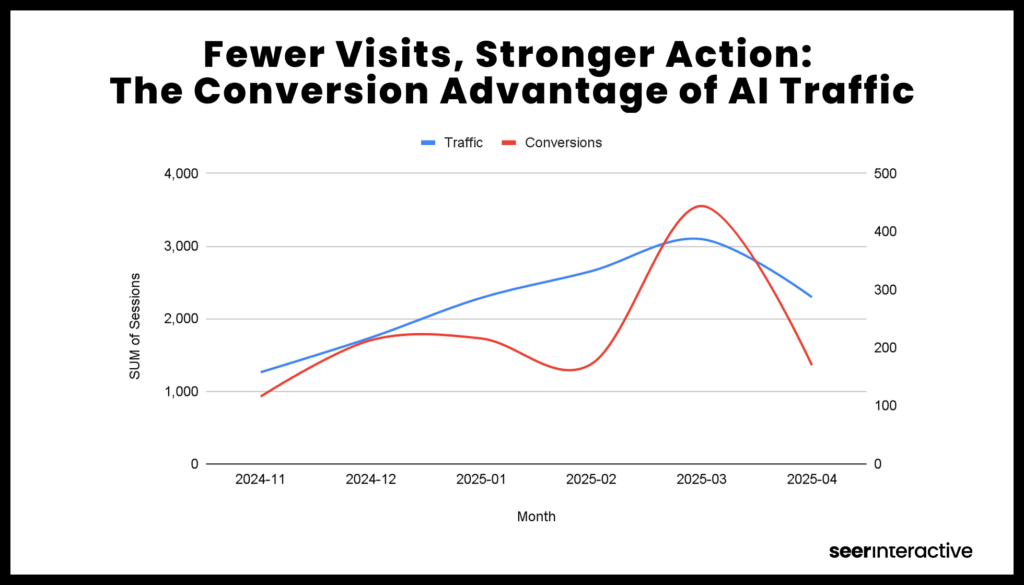
Does AI Search Traffic Convert Better Than Traditional Search? For Ahrefs, Yes: 0.5% of Visitors Drove 12.1% of Signups

Author: Ahrefs
Publish Date: 16/06/2025

Ahrefs reports that AI search visitors convert 23× better than traditional search visitors: 12.1% of Ahrefs signups stem from AI traffic, despite it only representing about 0.5% of visits. AI-sourced users go through 50% more pages and have lower bounce rates, but spend less overall time onsite. These signals point to higher purchase or signup intent—AI users seem to come more ready to act. The authors caution, though, this trend may not scale linearly as AI becomes more common, and analytics attribution remains imprecise.

ViewClick to open

80% of Our AI Search Traffic Goes to Our Homepage, Product Pages, and Free Tools

Author: Ahrefs
Publish Date: 16/06/2025

This analysis of Ahrefs Web Analytics (30‑day timeframe) reveals 80% of AI-sourced visits land on high-intent pages: free tools (36.5%), product pages (23.1%), and the homepage (20.4%). This contrasts with domain advice focused on informational content—AI assistants disproportionately direct users toward conversion-focused or branded pages. A small percentage (~3.6%) even lead to non-existent “hallucinated” pages, mainly from ChatGPT. While “best-of” content and guides still attract AI traffic, brands should optimise high-intent pages for AI visibility. The study also encourages monitoring misdirected AI traffic and setting up redirects for hallucinated URLs.

ViewClick to open

86% of Top Mentioned Sources Are Not Shared Across ChatGPT, Perplexity, and AI Overviews

Author: Ahrefs
Publish Date: 12/06/2025

Ahrefs Brand Radar analysed ~76.7M Google AI Overviews, 957k ChatGPT prompts, and 953k Perplexity prompts for June 2025. It found striking divergence in citation sources: only 7 out of the top 50 domains were common to all three platforms—just 14%. Preferences differ by assistant: Google AI leans heavily on authoritative and user-generated sites (Wikipedia, YouTube, Reddit), ChatGPT cites publishers and news outlets, and Perplexity draws from regional and niche sources. This highlights platform-specific algorithmic biases and emphasizes that SEO optimisation should tailor for multiple AI ecosystems, not just Google.

ViewClick to open

AI Scraping Is On The Rise. TollBit State of the Bots - Q1 2025

Author: Tollbit
Publish Date: 11/06/2025

TollBit’s updated Q1 2025 report (following on from its Q4 2024 report) shows AI assistant traffic rose 39.8% quarter-over-quarter, now making up 4.7% of total traffic across 2,752 publisher sites. ChatGPT led with 55.3% of identifiable assistant visits, followed by Perplexity (22.7%) and Claude (6.9%). News and health sites continue to see the highest AI-driven engagement. The report also highlights a sharp increase in “shadow AI traffic” - bots with hidden or no user-agent strings - accounting for 62% of all assistant traffic, up from 49% in Q4 2024. This growth signals increasing AI content scraping without attribution or monetisation. TollBit again urges publishers to recognise AI as a traffic source requiring visibility, governance, and monetisation strategies.

View: Click to open

The 10 Most Mentioned Domains for ChatGPT, Perplexity, and AI Overviews Across 78.6M Searches

Author: Ahrefs
Publish Date: 11/06/2025

Ahrefs used its Brand Radar dataset (~76.7 M Google AI Oversees, 957 k ChatGPT, 953 k Perplexity prompts) to identify the top 10 domains most frequently cited by AI assistants. Wikipedia leads overall—16.3% in ChatGPT, 12.5% in Perplexity, and 8.4% in Google AI Oversees—while YouTube ranks high in Perplexity (16.1%) and Oversees (9.5%) but is absent in ChatGPT. Google favours user-generated content (Reddit, Quora) in Oversees (7.4% and 3.6%), whereas ChatGPT emphasises news outlets like Reuters, AP, and AS.com. Impression/potential reach analysis, weighted by search volume, shows institutional and medical sources like Mayo Clinic also hold considerable visibility in Oversees. The findings underline how each AI assistant follows a distinct content citation bias.

ViewClick to open

We Studied the Impact of AI Search on SEO Traffic. Here’s What We Learned.

Author: Semrush
Publish Date: 09/06/2025

Semrush examined over 500 SEO and digital marketing query topics to project how AI search will affect traffic and revenue. Their model indicates that by early 2028, AI-sourced visits could surpass traditional search visits for such topics—potentially sooner if Google’s AI Mode becomes the default. This trend suggests AI search's rapid ascension—with significant implications for industry traffic patterns and optimisation strategies.

View: Click to open

Semrush AI Overviews Study: What 2025 SEO Data Tells Us About Google’s Search Shift

Author: Semrush
Publish Date: 05/05/2025

Semrush analysed over 10 million keywords (January–March 2025) to assess the growing prevalence of AI Overviews in SERPs. The share of queries triggering AI Overviews doubled from 6.49% in January to 13.14% in March. These features predominantly appear on informational queries (88.1%), and navigational triggers also doubled. Sector-wise, topics like science (+22.3%), health (+20.3%), people & society (+18.8%), and law & government (+15.2%) saw the highest increases. Surprisingly, zero-click rates for the same keywords decreased slightly after AI Overviews were introduced—suggesting users may still click through after reading a summary. The key takeaway: AI Overviews are reshaping search—marketers must optimise for them to maintain visibility.

ViewClick to open

AI Overviews Reduce Clicks by 34.5%

Author: Ahrefs
Publish Date: 17/04/2025

Analysing 300K informational keywords, this Ahrefs study compared CTRs from March 2024 (pre-AI Overviews) and March 2025. Position‑one CTR dropped from 5.6% to 3.1% for those without AI Overviews, while AI Overview-triggering keywords saw CTR fall even more dramatically—from 7.3% to 2.6%. This amounts to an estimated 34.5% CTR reduction attributed directly to AI Overviews. The mechanism resembles Featured Snippets, providing answers directly in the SERP and decreasing traditional link clicks. Despite Google's assertion that links within Overviews get more traction, Ahrefs notes that current tools cannot differentiate these click types. The study warns that as AI summaries become more routine, passive "zero-click" searches will likely increase, further impacting organic traffic.

ViewClick to open

Google AI Overviews: New CTR Study Reveals How to Navigate Negative SERP Impact

Author: Amsive
Publish Date: 16/04/2025

This study analysed 700K keywords across five industries and found that the introduction of Google’s AI-generated Overviews has significantly disrupted clickthrough rates. On average, CTR dropped by 15.5%, with non-branded (–19.98%) and lower-ranked keywords (–27.04%) hit hardest. Overlapping Featured Snippets combined with AI Overviews led to an even steeper CTR decline of 37%. Interestingly, branded queries that did trigger an AI Overview saw a CTR increase of 18.7%, suggesting brand credibility can offset visibility loss. The research recommends adapting SEO strategy: aim for top positions but also focus on securing Featured Snippets, optimise for high-intent non-branded queries, and double down on branded content. The takeaway is to recalibrate your SEO playbook for an AI-dominated SERP environment.

ViewClick to open

Does Brand Awareness Impact LLM Visibility?

Author: Seer Interactive
Publish Date: 16/04/2025

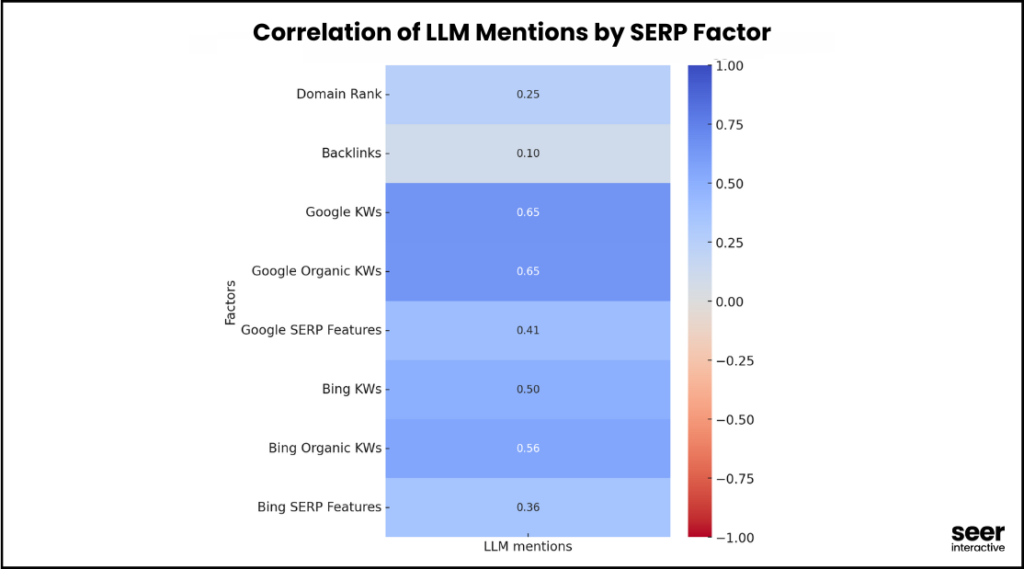
Seer Interactive analysed correlations between brand mention volume (MSV) and LLM visibility. Overall correlation was modest (ρ ≈ 0.18), second only to Domain Rank (ρ ≈ 0.25). In high-trust verticals like finance, brand awareness appears to meaningfully improve LLM mentions. The conclusion: awareness contributes to LLM visibility, but only in tandem with strong domain authority, backlinks, and credible content. For industries reliant on trust, awareness-building campaigns—PR, expert engagement, publisher mentions—are recommended to boost AI visibility.

ViewClick to open

Marketing’s New Middleman: AI Agents

Author: Bain
Publish Date: 14/04/2025

Bain & Company argues that AI agents are fast becoming influential intermediaries between brands and buyers, shifting how consumers and businesses make decisions. These agents don’t just provide information - they make or narrow down choices. This has major implications for marketers, particularly in B2B and high-consideration consumer sectors. Key data and insights include: 28% of consumers have already used generative AI to assist in purchasing decisions. Among these, 70% say it improved decision quality and 63% say it saved time. Bain predicts AI agents will soon dominate early discovery and evaluation stages of the buyer journey.

View: Click to open

AI Scraping Is On The Rise. TollBit State of the Bots - Q4 2024

Author: Tollbit
Publish Date: 24/02/2025

TollBit’s Q4 2024 report analyses 295 million visits across 2,420 publisher sites to track how LLMs and bots interact with web content. The headline finding: traffic from AI assistants and bots increased by 17.2% quarter-over-quarter, now accounting for 3.4% of total traffic. ChatGPT, Perplexity, and Claude led the charge, with ChatGPT visits up 20.7%. News publishers and health sites saw the highest share of AI traffic, with Perplexity disproportionately favouring health content. The report also notes a rise in unidentified bot traffic (up 30.4%), suggesting growing use of non-transparent agents. TollBit emphasises that most of this AI traffic is unmonetised—publishers receive no revenue despite their content powering AI outputs. To address this, TollBit promotes its tooling to help publishers identify AI agents, measure content usage, and control access. The report urges media companies to begin treating AI traffic like a commercial channel and to prepare monetisation strategies accordingly.

View: Click to open

87% of SearchGPT Citations Match Bing’s Top Results

Author: Seer Interactive
Publish Date: 06/02/2025

Seer Interactive found that in SearchGPT (ChatGPT with live search), 87% of citations align with Bing’s top 20 organic results, with many from the first page. In contrast, only around 56% match Google’s top results. This suggests that Bing’s SERP landscape heavily influences ChatGPT’s web citations. The study advises SEO to diversify efforts—tracking Bing alongside Google—and consider partnerships with external trusted publishers.

ViewClick to open

Google Triggers 100% More AI Overviews for Longer Queries, New Report from BrightEdge Finds

Author: Brightedge
Publish Date: 30/01/2025

From September to December 2024, the proportion of long-tail queries (eight or more words) triggering AI Overviews doubled, showing Google’s increasing confidence in answering complex questions with AI. Approximately 25% of those longer queries now generate an AI Overview. BrightEdge highlights Google’s ability to handle nuance at scale, and implies SEO strategies must now cater to longer, more conversational queries.

ViewClick to open

Marketing Leaders Want to Meet AI Search Head-On: New Survey Results

Author: Botify
Publish Date: 28/01/2025

Botify’s January 2025 survey found marketing leaders recognise the urgency of integrating AI search strategies. Organisations are prioritising structured data, metadata automation, AI-ready indexing, and cross-platform tracking (Google, Bing, ChatGPT). Key initiatives include SmartIndex (real-time AI-friendly indexing), SmartContent (AI-enriched content generation), and SmartLink (automated internal linking), showcasing a strategic shift to support visibility across both traditional and AI search.

ViewClick to open

STUDY: What Drives Brand Mentions in AI Answers?

Author: Seer Interactive
Publish Date: 07/01/2025

Seer analysed 10,000 LLM-generated brand-recommendation prompts (mainly finance and SaaS). Page‑1 Google rankings had the strongest correlation with brand mentions (~0.65), followed by Bing (~0.5–0.6). Surprisingly, backlinks and multimedia content had little impact. After filtering out aggregators and forums, correlation strengthened, reinforcing the importance of rankings and PR/partnership strategies. The study suggests that while SERP prominence matters, brands should also invest in PR and partnerships to boost LLM mention likelihood.

ViewClick to open

New Report From .Trends & Statista Reveals How AI Search is Changing the Web

Author: Semrush
Publish Date: 02/12/2024

This report provided early market insights, highlighting that as of July 2024, ChatGPT and Google’s Gemini dominate AI search traffic—capturing around 78% between them, with Perplexity and Bing composing the rest. It also noted approximately 13 million US adults had already adopted generative AI as their primary search tool, with projections reaching 90 million by 2027. It confirms AI search isn’t niche—it’s becoming mainstream, demanding adaptation from marketers and content creators.

ViewClick to open

We Studied 200,000 AI Overviews: Here's What We Learned

Author: Semrush
Publish Date: 30/10/2024

Focusing on the structure of Google AI Overviews, Semrush analysed how many top‑10 organic URLs appear in AI Overviews. They found low overlap: over 80% of mobile AI Overviews include three or fewer top‑10 results and only 46% of desktop and 34% of mobile Overviews included the #1 organic result. Ads rarely overlap with AI‑shown URLs. This suggests AI Overviews use different selection criteria, meaning high organic rank doesn't ensure an AI citation. Brands have a chance to feature in Overviews even if they aren’t top in classic SEO—communicate expertise clearly to be surfaced by these AI summaries.

ViewClick to open

AI Overviews Study: Inside Google's New Search Reality

Author: Botify / DemandSphere
Publish Date: 01/10/2024

Botify’s Q4 2024 report, based on 120 000 SERPs, shows AI Overviews appearing in up to 47% of searches and occupying 75.7% of mobile viewport space when paired with Featured Snippets. Most AI Overview citations come from top‑12 organic rankings, with strong semantic alignment between page content and AI summaries. The study calls for optimising for ranking and content similarity to increase AI Overview placement.

ViewClick to open

New Research From BrightEdge Finds Google's AI Overviews Are Getting Smarter

Author: Brightedge
Publish Date: 19/09/2024

BrightEdge’s research reveals Google’s AI Overviews are evolving: they now lean heavily on specialised expert sources, comparative shopping content, and visual modules like carousels. This signals more discerning source selection and richer formats. Additionally, Google’s SearchGPT referral growth is outpacing competitors—underlining that businesses need to target both search ranking and source authority to capture AI visibility.

ViewClick to open

AI Overviews: Impact on Google CTR

Author: Seer Interactive
Publish Date: 04/11/2025

Organic CTR for queries with AI Overviews dropped 61% (from 1.76% to 0.61%). Paid CTR dropped 68% (from 19.7% to 6.34%). Even queries without AI Overviews saw organic CTR fall 41%, suggesting broader behavioural change beyond AI Overview presence alone. Brands cited in AI Overviews earned 35% higher organic CTR and 91% higher paid CTR than non-cited brands.

ViewClick to open

What Really Drives ChatGPT Citations

Author: SE Ranking
Publish Date: 12/2025

Referring domains are the single strongest predictor of ChatGPT citation. Around 2,500 referring domains correlate with 1.6 to 1.8 citations. Sites with more than 350,000 referring domains average 8.4 citations. Domains active on Trustpilot, G2, Capterra, and Yelp earn 3x more citations than those without profiles. Pages with First Contentful Paint under 0.4 seconds average 6.7 citations versus 2.1 for slower pages. Content updated within the past three months averages 6 citations versus 3.6 for untouched content. LLMs.txt files showed negligible impact.

ViewClick to open

AI Overviews and AI Mode Citation Overlap

Author: Ahrefs
Publish Date: 02/2026)

AI Overviews and Google AI Mode cite different sources: only 13.7% of citations overlap between the two features. YouTube mentions and branded web mentions are the top factors correlating with AI brand visibility across ChatGPT, AI Mode, and AI Overviews. AI Overview content changes 70% of the time for the same query, and when it generates a new answer 45.5% of citations are replaced.

ViewClick to open

How Users Interact with Google AI Overviews

Author: Pew Research Center
Publish Date: 07/2025

Click-through rate drops from 15% to 8% when an AI Overview is present. Only 1% of searches lead to users clicking a link within an AI Overview. Users end their search session 26% more often when an AI answer appears, compared to 16% for results pages without AI Overviews.

ViewClick to open

Zero-Click Search and Google Traffic Growth

Author: Pew Research Center
Publish Date: 07/2025

Click-through rate drops from 15% to 8% when an AI Overview is present. Only 1% of searches lead to users clicking a link within an AI Overview. Users end their search session 26% more often when an AI answer appears, compared to 16% for results pages without AI Overviews.

ViewClick to open

Most Cited Domains in AI (3-Month Study)

Author: SemRush
Publish Date: 10/11/2025

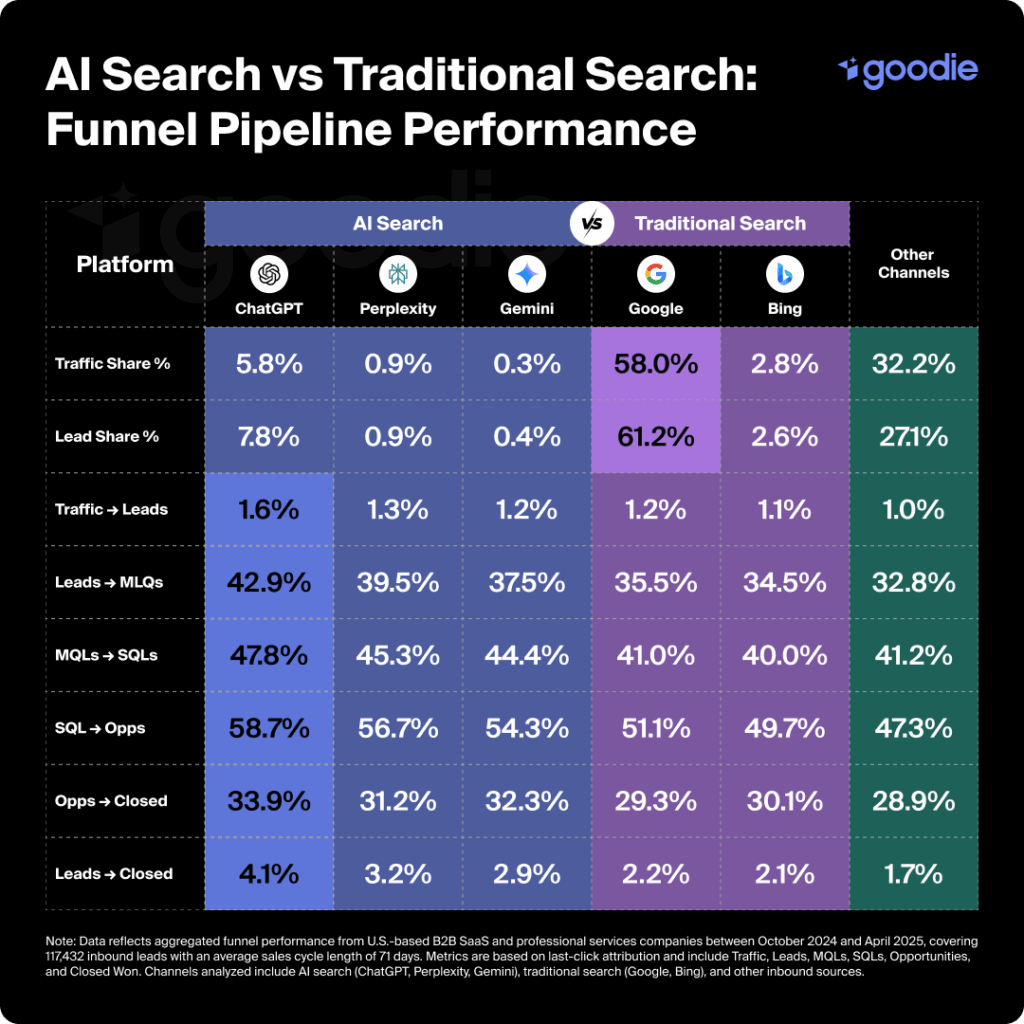
ChatGPT cited Reddit in nearly 60% of responses in early August before collapsing to around 10% by mid-September 2025, coinciding with a Google search parameter change. AI Mode consistently cited LinkedIn in nearly 15% of its responses. Forbes doubled its ChatGPT citation rate after September 2025. LLM visitors convert 4.4x better than organic search visitors (also from Semrush July 2025 research, 90% of ChatGPT cited pages rank at position 21 or lower in traditional search).

ViewClick to open

Ben Carter

July 12, 2025

Generative Engine Optimisation

Is it really possible to be a GEO AI search agency expert?

Generative Engine Optimisation (GEO) is brand new territory in lots of respects. Who are the experts?

We think so - and we think FirstMotion are GEO experts. But for different reasons than you may think.

Generative Engine Optimisation (GEO) is brand new territory. We're at the very beginning of understanding how tools like ChatGPT, Perplexity, Claude, and Google AI Overviews surface, cite, and synthesise information.

The GEO landscape is shifting fast

The pace of change in AI search is unlike anything we've seen before in digital marketing. One week, Perplexity quietly launches a new model. The next, ChatGPT gets real-time browsing powered by Bing. Then Perplexity launches its own browser, and OpenAI announces the same. Meanwhile, Google’s AI Overviews are causing traffic chaos for brands who are seeing organic clicks steeply in decline. There are lots of statistics showing just how much AI search is changing things.

Even if someone was a 'GEO expert' yesterday, a model update tomorrow could instantly make their assumptions irrelevant. But that's not dissimilar to how it's always been with SEO too.

So expertise in GEO doesn’t come from knowing everything. Being a GEO expert agency comes from knowing how to learn fast when everything changes.

SEO was never certain either

This isn’t a new challenge.

In the world of 'traditional' SEO, one day you’re ranking #1. The next, an algorithm update wipes causes lots of disruption.

We’ve always known that SEO success came from experimentation, ethical optimisation, and trying to stay ahead of the curve. GEO is no different.

In fact, we would argue 'SEO expert' has always been misleading. It was never about mastering the rules, it was about mastering the process of adapting to them.

GEO is harder to measure - for now

In some respects we’re flying blind when it comes to GEO.

There’s no Search Console for LLMs. No robust attribution tracking. No clear visibility into how people found you via ChatGPT or Perplexity, especially when your brand gets mentioned without a link.

That’s why analytics tools like Peec AI are so valuable (and why we’ve partnered with them at FirstMotion). But even they’re tracking probabilities of being visible, not specific rankings. This is a new kind of visibility and we need new tools, new frameworks, and new ways of thinking to make sense of it.

Will OpenAI release better analytics for LLM driven search? Almost like a Google Search Console equivalent for AI? Our bet would be yes. But until then, we need to stay evidence based and methodical.

Here's our recent post on why the B2B dark funnel is darker than ever because of AI right now.

GEO isn't a skillset - it’s a cross-disciplinary strategy

The truth is, no single person can own GEO.

It cuts across product marketing, demand generation, content strategy, PR, analyst relations, SEO, social media and data.

  • You need deep audience intelligence to map prompts across the buyer journey.
  • You need semantic content structuring to make your material citable.
  • You need offsite influence on trusted sources like G2, Reddit, and Gartner.
  • You need visibility tracking that can’t be found in your CMS or GA4.

GEO isn’t a vertical. It’s a layer across your entire go-to-market strategy. That's why at FirstMotion we focus on the AI native B2B buyer journey, not just AI search being a visibility measure.

FirstMotion: GEO & AI SEO expert agency

We position ourselves as a specialist, leading and expert generative engine optimisation & AI search gency, because of how deeply we're researching in the space and how methodical our approach is.

We promise every client that comes on a journey with us that:

  • Every recommendation is backed by research, not guesswork.
  • Every framework is tested across real buyer journeys and ICPs.
  • Every insight we share is part of our commitment to learning in public.

We’ve built our Contextual Journey™ platform because we believe GEO strategy must start with enriched audience and buyer intelligence. Not prompt guessing.

If you want to keep up to date with all the latest GEO research, studies and data driven insights, check out our GEO research database.

Read more: how to pick a B2B SaaS focused GEO / AI search agency

Alex Price

July 11, 2025

Generative Engine Optimisation

Is Google AI Overviews behind your organic traffic drop? Here’s how to diagnose it

Google AI Overviews and AI mode is changing the search results page - here's how to diagnose if it may be causing your organic traffic drop.

If you’ve noticed your organic traffic dropping recently – even though your SEO performance looks fine – you’re not alone. In fact, we’re seeing this across multiple B2B software brands right now.

The scary part? Traditional SEO metrics might tell you everything’s improving. You’re climbing rankings. Visibility is up. But clicks are falling off a cliff.

So what’s going on?

Google AI overviews are cannibalising your clicks

Google’s AI Overviews are now occupying serious real estate at the top of many search result pages - and appearing for more and more searches. They summarise answers to user queries before anyone even gets to the blue links. Which means:

  • Even if you rank #1, you’re further down the page under the AI Overview
  • The answer is already there, users don’t need to click
  • Your content is fuelling the overview, but you’re not getting the visit

In short: in certain cases you may be being used but not rewarded.

Look at this data if you really want to see the impact:

Users are moving to AI assistants for search

In lots of cases, users are increasingly skipping Google altogether.

Read our stats on the rise of AI search over Google here.

ChatGPT, Perplexity, Claude - these tools are fast becoming the default research assistants for B2B buyers. They’re asking prompts, not typing keywords. They’re getting citations and brand names straight from the LLM’s mouth – no links, no visits, no traceable click path. AI tools are changing the B2B buyer journey, acting as buyer enablement co-pilots across the journey.

How to diagnose what if AI Overviews is causing the traffic drop

Here’s how to investigate whether AI search is to blame for your organic traffic fall.

Step 1: Head to Google Search Console

In GSC, go to the Performance section.

Google recently confirmed that AI Overviews data is now included in total impressions and clicks – but it’s not filterable (yet).

So here’s what to look for:

  • If visibility (impressions) is flat or increasing…
  • But clicks are falling…
  • That’s a strong signal that Google’s AI Overviews are satisfying the query before users reach your site.

A classic symptom: rising visibility, plummeting click through rate.

Step 2: Analyse Specific Queries

Focus on your key commercial and high converting queries.

Look for:

  • No change in ranking position (it may still say '1', but the entire SERP has shifted down because of AI overviews)
  • Decline in clicks with no ranking drop
  • Higher impressions but flat engagement

These are red flags that the SERP layout has changed – and you’ve been pushed out by AI.

Step 3: Watch for Brand Mentions with No Attribution

LLMs like ChatGPT often mention brand names without including a link.

This creates 'dark' branded search behaviour: users hear about you in AI responses, then Google your brand later or go direct.

To check this:

  • Look in GSC for rising branded queries even as generic queries decline
  • Compare your brand name traffic against your SEO targeted pages

If branded searches are up but overall organic traffic is down, the LLM dark funnel could be at work.

Step 4: Audit Your AI Visibility

Take your most important keywords or content themes, and translate them into prompts that buyers might use mapped onto stages of their buyer journey.

Then:

  • Use a tool like Peec AI to check if your content is being cited in ChatGPT, Perplexity or Google AI Overviews
  • Compare your visibility to key competitors
  • Note which content shows up in AI answers vs what performs in Google

This is where the gap becomes obvious.

Summary: your AI search visibility checklist

If you can answer yes to three or more of the below, it’s time to take GEO seriously:

  • Organic traffic down, but rankings or impressions stable
  • Drop in CTR across top queries
  • Google Search Console shows higher impressions, fewer clicks
  • Spike in branded searches despite drop in generic traffic
  • You don’t appear in AI answers for key prompts

Ben Hodgson

July 11, 2025

Generative Engine Optimisation

Generative Engine Optimisation & AI Search: Your questions answered

Frequently asked questions about Generative Engine Optimisation and how to improve visibility inside AI search engines.

The world of search is changing - fast and forever. In fact, much of the change has already happened.

If you’re a B2B marketer still focused solely on Google rankings, you’re missing the new front lines of visibility: AI search assistants like ChatGPT, Perplexity, Claude and Google AI Overviews along with Gemini..

We call it GEO (Generative Engine Optimisation) and it's changing how B2B buyers discover, research, and evaluate software.

This post tackles the most common (and important) questions we hear from marketers trying to get their heads around GEO. No fluff, no hype, just sharp answers grounded in what’s happening now.

What actually is GEO?

Generative Engine Optimisation (GEO) or AI Search is the process of improving your visibility, influence, and presence inside AI powered search tools.

That includes tools like:

  • ChatGPT with browsing enabled
  • Perplexity (which combines LLMs with real-time search)
  • Claude, Gemini, and more
  • Google's Search Generative Experience (SGE)

Unlike traditional SEO, where keyword volumes were easy to measure and rankings were static and predictable, GEO is probabilistic - every prompt gets a slightly different answer, pulled from different sources, depending on how it’s phrased and who’s asking.

We believe in a B2B marketing context, GEO is:

  • Prompt driven, not keyword driven
  • Built for LLMs, not legacy search engines
  • A process of buyer journey orchestration across the full length of the B2B buyer journey, not just a measure of brand visibility

Is it called GEO or AIO or AEO or LLMO?

Marketers and agencies (let's be honest, mainly agencies) are throwing all sorts of acronyms around:

  • GEO = Generative Engine Optimisation
  • AIO = AI Optimisation
  • LLMO = Large Language Model Optimisation
  • AEO = Answer Engine Optimisation (typically used in voice/search)

We use GEO because it reflects a broader truth: search has shifted to generative engines. It’s not about optimising for one tool. It’s about understanding how AI systems are generating answers, and making sure you’re present when they do.

We also feel GEO is a nice natural next iteration of SEO.

What is a GEO agency?

Think of a GEO agency like the next generation of a SEO agency. A GEO agency should help you:

  • Understand how your buyers are using AI search assistants
  • Track your brand’s visibility across generative tools
  • Map prompts to buyer journey stages
  • Influence the sources LLMs pull from
  • Build content strategies optimised for prompt driven journeys
  • Monitor and adapt visibility over time

At FirstMotion, we specialise in B2B software. Our methodology is built around deep audience intelligence and buyer context, prompt mining, and influence intelligence - not just guessing prompts and writing blog posts.

How does GEO differ from SEO?

At a foundational level, SEO was about rankings. GEO is about probabilities.

In SEO, you aimed to get on page one of Google. Ideally position number one. In GEO, there’s no single ranking - just the likelihood of your brand or content being surfaced in response to a prompt.

GEO is more dynamic, more contextual, and more dependent on structured data, semantic language, and trust signals from third party sources.

That said, there are plenty of areas of overlap. In some verticals we've seen strong correlation between 'traditional SEO performance' and AI search performance. And some of the 'tactics' we use to improve a brand's visibility and performance in GEO will be similar to SEO.

It's not about one or the other - it's about understanding your customers, the tools they use to search, discover and evaluate, and shaping strategies to influence their journeys in the right way and the right time.

How does AI search or GEO change the B2B buyer journey?

It compresses it. Blurs it. Personalises it. Makes it harder to measure. But also presents lots of opportunities for B2B software brands to accelerate the sales cycle, influence it earlier and turn AI search into a channel that drives growth.

B2B buyers now use ChatGPT and Perplexity as buyer enablement co-pilots - not just top of funnel discovery tools.

GEO doesn’t just influence top of funnel. It influences:

  • How buyers shortlist vendors
  • What features they evaluate
  • What reviews or use cases they see
  • What integrations or differentiators get mentioned
  • What questions they ask vendors
  • How they evaluate and make a final decision

Our own framework, PromptPath™, aligns GEO strategy to the full buyer journey:

  1. Problem Identification
  2. Solution Exploration
  3. Requirements Building
  4. Supplier Evaluation

And we then map ICPs, personas and prompts to every B2B buyer journey stage using our ContextualJourney™ technology platform.

What are the best analytics tools for measuring AI visibility?

Right now, the most useful tool in our stack is Peec AI which is a purpose built analytics tool for AI prompt visibility tracking across ChatGPT, Perplexity, Google AI Overviews and other platforms.

We also use our own ContextualJourney™ platform for the audience intelligence, prompt mining and some of the content strategy parts of our work and to help us reverse engineer generative engine visibility success for our clients.

GEO visibility is harder to measure than SEO - but it’s possible, it's essential, and it should be happening consistently.

What’s the most important part of a GEO strategy?

Without question, our perspective at FirstMotion is that it's audience intelligence.

You can’t optimise for prompts if you don’t deeply understand your ICPs, personas, and buyer journey, along with some strong competitor analysis.

At FirstMotion, our ContextualJourney™ platform uses millions of B2B buyer data points, enrichment, intent data and AI to:

  • Deeply understand B2B buyer pain points and goals
  • Building buying units
  • Understand the buyer journey
  • Translates those insights into likely AI prompts (searches)
  • Builds a Prompt Matrix mapped across journey stages

No prompt strategy is complete without deep, enriched buyer context - and we don't believe it's possible to define a winning AI search content strategy without deep audience intelligence.

Will AI tools like ChatGPT eventually overtake Google?

Maybe not entirely. But in many B2B software categories, they're already the first stop - especially for:

  • Problem framing
  • Tool comparison
  • Feature evaluation
  • Writing RFPs or spec sheets
  • Identifying possible risks/red flags
  • Asking what to ask on a demo call

Think less in terms of Google vs ChatGPT. Think more in terms of parallel influence. Either way, we believe AI tools are playing an active role in the decision making unit.

GEO is already shaping decisions - and that's only going to increase.

Is GEO just about discovery and top of funnel?

Not at all. We strongly believe AI tools are buyer enablement co-pilots across the full B2B buyer journey. We think less in easy to attribute linear funnels, and more in non-linear journeys that are complex, considered and hard to measure.

GEO can influence:

  • What problems buyers prioritise
  • Which tools they consider
  • How they build shortlists
  • What questions they ask during demos
  • How confident they feel in supplier selection

That’s not top of funnel. That’s revenue impact.

Are sources like G2, Gartner, Reddit & Quora more important for GEO?

Yes, massively. At FirstMotion we're doing lots of search into the sources that influence B2B software related search queries.

LLMs don’t just crawl your homepage. They pull trusted, cited content from:

  • G2, Capterra, TrustRadius
  • Reddit, Quora, LinkedIn Pulse
  • Forrester, Gartner and other analyst reports
  • Niche industry media sources
  • Third party blogs, integrations directories, and guest posts

We call this influence intelligence - knowing which sources AI tools cite for prompts in your category, and earning visibility in those locations.

Do I need to focus on Bing for to improve visiblity in ChatGPT?

If you want to be visible in ChatGPT’s web search mode, then yes, 100%.

When ChatGPT doesn't have a confident answer within its training data (the knowledge already built into the model), it uses Bing to search the web. If your content isn’t ranking on Bing, ChatGPT may never find it.

We cover this in detail in this post.

How do I figure out what prompts my buyers are using?

That’s the million dollar question, and the heart of GEO.

At why at FirstMotion, we start with strong audience intelligence that considers:

  • Not just job titles, but buying behaviour
  • Use lots of data enrichment and intent data sources
  • Use AI to reverse map likely prompts by persona and journey stage
  • Analyse source language from reviews, Reddit, LinkedIn, etc
  • Feed all this into our Prompt Matrix for each client

It’s not about guessing or simply taking 'SEO keywords' and converting them easily into prompts. Prompts are much more contextual, and often much longer than a keyword.

We wrote this post exploring the type of prompts B2B software companies should think about being visible for.

How can I track clicks from AI answers in ChatGPT?

Not reliably, and that’s part of the dark funnel problem we unpack in this post.

ChatGPT often paraphrases your content without linking. It might mention your brand name, but not include a link to your site. Buyers may then search your brand separately in Google after seeing a mention. That means no attribution, no UTM, no referrer from ChatGPT - even through ChatGPT was where the discovery moment happened, or what prompted the user to come to your site.

One thing to keep an eye out for is an increase in branded searches to your site. Maybe a tool like ChatGPT is recommending your brand name, but the 'referrer' is still organic search because the user still has to Google you.

We'll keep this page regularly updated with some of our most frequently asked questions about AI search and the shift from SEO to GEO - let us know if you have questions you want answering.

If you want to keep up to date with all the latest GEO research, studies and data driven insights, check out our GEO research database.

Ben Carter

July 10, 2025

Generative Engine Optimisation

GEO vs SEO: what's the difference?

Wondering what the difference really is between SEO and GEO? Here's everything you need to know about AI search.

The world of search has shifted. Again.

But this time, it’s not a Google algorithm tweak or a new SERP layout. This is bigger and more fundamental.

Generative Engine Optimisation (GEO) isn’t just a buzzword, it’s a new reality. And if your growth team is still treating SEO like it’s 2018, you’re not just missing traffic. You’re missing influence.

In this post, we break down the core differences between SEO and GEO, and why the smartest B2B software brands are already planning for both.

What Is SEO?

Search Engine Optimisation (SEO) is the practice of increasing visibility in traditional search engines like Google. For years, the playbook was simple (but not easy):

  • Research keywords
  • Optimise your site
  • Write content
  • Build backlinks
  • Climb the rankings
  • Get clicks

SEO’s strength was predictability. You knew what people were searching for. You had tools like Ahrefs and SEMrush to estimate volumes. You could reverse engineer what worked. And everything was deterministic - keyword volumes were easy to measure and rankings were precise.

What Is GEO, and why is it different?

Generative Engine Optimisation (GEO) is about visibility inside AI generated answers, not just on a list of blue links. When users ask questions in ChatGPT or Perplexity they often get direct and contextual answers, personalised to them - sometimes without any links at all.

And those answers? They’re not always sourced from the biggest domain. Or the page with the most backlinks. They’re generated from what the model believes is most relevant and trustworthy source.

GEO is how you show up in those answers.

SEO vs GEO: The core differences

FeatureSEOGEO
PurposeRank in search engine resultsBe cited/included in AI generated answers
AudienceHumans searching via GoogleLLMs generating responses in tools like ChatGPT
Discovery MethodCrawl > Index > RankIngest > Extract > Synthesise
Main MetricOrganic traffic, CTR, rankingsVisibility in AI answers, citation frequency
Optimisation TacticsKeywords, content, backlinks, technical SEOPrompt/intent alignment, content, offsite influence
ToolsAhrefs, Moz, SEMrush, GSCPeec, ContextualJourney™
Traffic FlowClick-through to siteMentioned in answer, may or may not drive click
Source of ResultsCrawled & indexed website content Training data built into model, or web search (e.g. ChatGPT & Bing)
Update CadenceAlgorithm updates every few monthsModel & source updates weekly or even daily

Why GEO is important now

We’re seeing a shift in buyer behaviour, especially in B2B software purchase journeys:

  • Buyers use tools like ChatGPT to compare tools, shortlist vendors, generate RFP questions, shape evaluation scorecards and summarise reviews.
  • They don’t always click.
  • They trust the answer, not the link.
GEO doesn’t replace SEO, it runs in parallel. But it rewards different actions.

How GEO and SEO work together

Here’s what we’re seeing across our clients at FirstMotion:

  1. Great SEO = solid foundation.
    • Sites with high authority and well structured content often perform well in GEO too, but not always.
  2. But GEO rewards clarity and context, not just authority.
    • LLMs extract meaning. They want structure, factual statements, semantically rich formatting, and trusted sources.
  3. Offsite brand mentions matter more than ever.
    • Tools like ChatGPT pull heavily from G2, Gartner, Reddit, LinkedIn Pulse, Quora, and more.
    • GEO success means showing up in the right ecosystem, not just your own site.

GEO vs SEO: FAQs

1. What actually is GEO?

GEO stands for Generative Engine Optimisation, the art and science of being visible in AI generated answers, not just search engine results.

2. Is it called GEO or AIO or LLMO?

There’s lots of noise in the space. You’ll hear terms like AIO (AI Optimisation), LLMO (LLM Optimisation), and AISEO. We call it GEO, and we think that’s the clearest framing for what's really happening.

3. What is a GEO agency?

A GEO agency helps you understand how generative engines work, mine the prompts your buyers use, analyse where you're cited (or not), and build a strategy to show up in those answers.

4. How does GEO differ from SEO?

SEO = rank for keywords in Google. GEO = be cited in answers from AI tools like ChatGPT. Different discovery methods. Some different optimisation techniques. Different outcomes.

5. How does GEO change the B2B buyer journey?

AI assistants are now embedded in how B2B buyers research. They’re being used for comparisons, evaluation frameworks, and supplier shortlisting, not just discovery. GEO influences every stage of the buyer journey. AI assistants are buyer enablement co-pilots.

6. What are the best analytics/visibility tools for GEO?

We use Peec AI to track brand visibility across ChatGPT, Perplexity, Claude, Google AI Overviews and others. It shows which prompts you’re visible for, which influence sources are cited, and how competitors are performing in AI search.

7. What's the most important part of a GEO strategy?

Audience intelligence. At FirstMotion, we believe GEO must start with understanding how your buyers behave, what prompts they use, and how they evaluate vendors. That’s why we built our ContextualJourney™ platform, to help us map and enrich ICPs, personas, stages, and prompts to guide everything else.

8. Will AI tools eventually overtake Google?

Not immediately, but the shift is underway. We're seeing high intent search behaviour migrating to generative engines, but also lots of research and evaluation too. Here are some stats on AI's rise over Google.

9. Is GEO just about top of funnel?

Not at all. AI tools are becoming buyer enablement co-pilots - used throughout the journey, from problem identification to supplier evaluation. GEO helps you influence across the funnel - potentially at more opportunities than ever before.

10. Are sources like G2, Gartner, Reddit, and Quora more important for GEO?

Yes. These sources are frequently cited by LLMs. Being present, and well positioned, on them increases your chances of inclusion in generative answers.

11. Do I need to focus on Bing for GEO?

Yes, especially if you want to be visible in ChatGPT with web search enabled, since it pulls results via Bing’s API. Our full write up on this is here.

12. How do I figure out what prompts my buyers are actually using?

That’s the art of prompt mining. We analyse buyer roles, intent, and stage of journey to build a Prompt Matrix. You can’t guess your way into AI visibility, in a keyword-less world you need to unlock insights first.

13. What kinds of content get cited in AI answers?

Structured, well formatted contentListicles, comparisons, Q&As, frameworksContent hosted on trusted domainsClear statements of fact, statistics, or expert insight

14. How often should I monitor AI search visibility?

At a minimum monthly. Models update fast. Tools like Peec let us see which prompts you’re visible for, and when that changes.

15. Can I repurpose SEO content for GEO?

Sometimes, but it often needs reframing. GEO content should answer specific prompts, be highly contextual, and often live in or be repurposed in third party ecosystems too. There will be overlap in a SEO and GEO content strategy, but also some subtle but important differences.

16. Can I track clicks from AI answers?

Sometimes, but often, you can’t. Some AI tools don't include links to products they recommend in their answers. That’s why we talk about the AI-powered dark funnel.

Alex Price

July 9, 2025

Generative Engine Optimisation

AI Search Statistics: The rise of AI Search Over Google (Updated 2026)

Wondering how quickly AI search tools like ChatGPT are growing market share in search relative to Google? Here are some stats.

This article was updated on 18th March 2026

Google's dominance in search is being challenged faster than most expected. AI-powered tools led by ChatGPT are driving measurable shifts in how people search, what they click, and whether they click at all. This post was originally published in July 2025 with six statistics. We have now expanded it to ten, updated all figures to reflect primary research from late 2025 and early 2026, and added a last-updated date.

Here are some stats showing just how quickly the adoption of AI tools like ChatGPT are driving a change in search behaviour and usage - and potentially undermining Google's dominance.

1. Google drops below 90% share of the search engine market for first time

Google has always had the majority share of the search engine market, with over a 90% share. But in mid 2024, its share dropped below 90% for the first time. At the time of writing this post in July 2025, it has a 89.54% share of the market.

web stats
Source: Statcounter

In a similar time period, Bing has increased its share from 3.32% in February to just under 4% in July 2025. Whilst this change might not seem significant, it's interesting to think about when considering that OpenAI has a partnership with Bing and it uses Bing's index to search the web inside ChatGPT.

2. Gartner predicts a 50% drop in organic search by 2028 due to AI search

Based on its research and surveys, Gartner believes that the 'rapid adoption of GenAI in search engines will significantly disrupt CMOs’ ability to harness organic search to drive sales.'

Emily Weiss, Senior Principal Researcher in the Gartner Marketing Practice, added “Marketing leaders whose brands rely on SEO should consider allocating resources to testing other channels in order to diversify.”

3. Similarweb shows ChatGPT is now the 5th most visited website in the world

In April 2025 ChatGPT took over X to become the 5th most visited website in the world. Impressive by any measure, but even more so when you consider it wasn't even 3 years old at this point.

And what's just as impressive is the ongoing growth and just how quickly they are adopting new users.

Article content
Source: Similarweb

4. AI Overviews now appear in around 25% of all Google searches

AI Overviews appear on approximately 25% of Google searches as of November 2025, up from around 4% in January 2025. In health and science categories the figure can reach 40% or higher, according to this research from Conductor.

5. Ahrefs confirms AI Overviews reduce clicks by 58% for the top-ranking page

Ahrefs' study of 300,000 keywords (December 2025) found that AI Overviews correlate with a 58% lower click-through rate for the page ranking first. The effect is present even for pages that own the AI Overview citation — they see more impressions but fewer clicks per impression.

6. AI search traffic converts at significantly higher rates (but context matters)

Seer Interactive's case study (October 2024 to April 2025, B2B software client): ChatGPT converted at 15.9%, Perplexity at 10.5%, Claude at 5%, Gemini at 3%, versus Google organic at 1.76%. ChatGPT users also viewed 2.3 pages per session versus 1.2 for organic. Ahrefs reported internally that AI traffic drove 12.1% of all signups from just 0.5% of visits — a 23x conversion rate advantage. Semrush's broader July 2025 research found LLM visitors convert 4.4x better than organic on average. The effect is strongest for B2B and high-consideration purchases; it is weaker or neutral for impulse ecommerce.

7. Being cited in an AI Overview dramatically improves all search performance

Seer Interactive found that brands cited in AI Overviews earn 35% higher organic CTR and 91% higher paid CTR compared to brands that are not cited. The implication: the goal has shifted from ranking to being cited, with being cited unlocking compounding performance advantages across both organic and paid.

8. Referring domains are the single strongest predictor of AI citation

SE Ranking's study of 129,000 domains found referring domains are the strongest predictor of ChatGPT citation. Sites with more than 350,000 referring domains average 8.4 citations per response. Domains active on Trustpilot, G2, and Capterra earn 3x more citations than those without profiles. This means link-building for traditional SEO and AI search visibility are largely the same investment.

Tom Batting

July 8, 2025

Generative Engine Optimisation

Is Bing important when it comes to improving ChatGPT answer visibility?

If you're looking to improve your brand's visibility ChatGPT, Bing could be a more important search engine than ever before.

Marketers love to say “no one uses Bing.” And in the old world of SEO, they were probably right - for most brands, Google was the only search engine to think about. After all, Google has consistently had about a 90% share of the search engine market, whilst Bing has had less than 4%.

But if you care about visibility in ChatGPT and the world of generative engine optimisation, especially GPT-4o and later models with browsing enabled - you’re going to want to pay attention to Bing. There's lots of evidence showing AI tools rising in usage and potentially overtaking Google.

Why is Bing important for being more visible in ChatGPT? Because when ChatGPT doesn’t know something: it asks Bing.

The OpenAI, Microsoft, Bing Partnership

Microsoft has invested around $13 billion in OpenAI. In return, OpenAI’s technology now powers Microsoft’s Copilot experiences across Bing, Edge, Windows, and Office. But the partnership works both ways and one of the most important consequences is that when ChatGPT  browses the web, it does it through Bing.

  • ChatGPT’s web browsing plugin is powered by Bing’s API
  • Bing's index is what's used when ChatGPT browses the web
  • Microsoft’s infrastructure underpins OpenAI’s deployment at scale
  • Bing and Edge are increasingly integrated into how and where GPT-4o retrieves real time data

What triggers ChatGPT to do a web search?

ChatGPT doesn’t always search the web, sometimes instead relying on its own knowledge acquired through its training data, but here are common scenarios where it does:

  • Questions about recent updates or that rely on new information
  • “Best tools for X” where the model is uncertain
  • Certain pricing, availability, or comparison requests
  • Some region specific queries
  • Niche or lesser known areas where training data is sparse

It is also possible for users to explicitly request ChatGPT to do a web search, which they may want to do if they want ChatGPT to look beyond its own training data in order to give a better answer.

In these cases, ChatGPT uses Bing’s index to fetch results - and so if you’re not indexed in Bing, you're not making it into the answer.

Bing is a hidden GEO lever

Bing's search index and ranking algorithms are leveraged to ground ChatGPT's responses and provide citations, enhancing the reliability and transparency of the information provided. 

So Bing’s index is now the backbone of ChatGPT’s real time search. From product data to pricing, news to reviews, Bing gives ChatGPT access to a broad and constantly updated slice of the web. While it’s long been seen as Google’s second act, the OpenAI–Microsoft partnership has pushed Bing back into strategic relevance, especially for brands that want to be visible inside generative answers.

What kind of prompts might trigger a ChatGPT web search?

Whilst B2B software brands may not be as worried about real time information as other types of product or service provider, there are certain prompts relating to the B2B buyer journey that may leverage a Bing search.

Recent Information

For example ChatGPT's training data has a cut off. So if the prompt asks about anything updated recently, it’ll often go to the web.

Examples:

  • “What are the newest features in HubSpot’s Service Hub as of Q2 2025?”
  • “Did Salesforce just announce new AI functionality for Slack integration?”
  • “Latest comparison between Gong and Chorus for 2025?”

Comparisons

Another example is product comparisons, especially less mainstream or niche areas.

Examples:

  • “What’s the difference between Mutiny and Intellimize for website personalisation?”
  • “Compare ContractPodAi vs Malbek vs LinkSquares for CLM features and integrations.”
  • “How does Paddle stack up against Stripe for SaaS billing in Europe?”

Reviews & case studies

When a prompt calls for third party opinion, LLMs often browse forums, review sites, and user-generated content. Some of this information might be in the LLMs training data already, but some prompts might trigger a web search.

Examples:

  • “What do G2 reviews say about Chili Piper’s onboarding experience?”
  • “Are there any customer case studies for using Apollo.io with HubSpot?”
  • “What are the pros and cons of using Notion as a company knowledge base?”

Pricing, Licensing, and Packaging

LLMs typically do not retain accurate or up-to-date pricing info in training data, so often they’ll try to fetch it live.

Examples:

  • “What’s the latest pricing model for Contentful in 2025?”
  • “Is WorkRamp priced per seat or per module?”
  • “How much does an enterprise plan for Heap Analytics cost?”

Regional or Industry-Specific Queries

If the user adds context like geography or industry niche, ChatGPT may need to pull in more specific info.

Examples:

  • “Best CRM platforms for government contractors in the UK”
  • “CLM tools suitable for fintech companies with data residency in Europe”
  • “Local implementation partners for NetSuite in Dubai”

Security, Compliance & Technical Specs

When users ask detailed technical or compliance related questions, ChatGPT may decide to try and find the most current documentation.

Examples:

  • “Is AirTable SOC 2 compliant in 2025?”
  • “What kind of role-based access controls does Amplitude support?”
  • “Does Klaviyo store data in AWS or GCP?”

Event-Driven Prompts

These might relate to product launches, announcements, or market changes.

Examples:

  • “Which B2B software vendors announced funding rounds in June 2025?”
  • “Was Vanta featured in the latest Gartner Magic Quadrant?”
  • “Who’s sponsoring SaaStr 2025?”

What can you do to ensure visibility in Bing?

There are a number of steps you can take to think about your website's relationship with Bing, including first and foremost, making sure you submit your site to Bing Webmaster Tools.

Doing so will allow you to build a full picture of how Bing currently understands and indexes your content, and along with prompt visibility analytics enables you to start planning the steps to make sure Bing has the best chance possible to index your content. And most importantly, increase your chances of being included in an answer by ChatGPT.

Check out our FAQs page for your questions answered on GEO and AI search.

Ben Hodgson

July 7, 2025

 (edited)