Category: Generative Engine Optimisation

Explore FirstMotion's latest insights and company news.

Generative Engine Optimisation

How to gain visibility in generative AI answers: GEO / AI SEO for Perplexity and ChatGPT

Looking to improve visibility or 'rankings' in AI answers from ChatGPT? Here's how we approach improving generative engine and AI search visibility performance.

The world of SEO has changed - fast and forever. Optimising for AI search is a whole new world - and whilst there is certainly some overlap with old school SEO, there are also lots of areas requiring a fresh approach and a mindset shift.

As a B2B software focused AI SEO agency, here is an overview of some of the things we look at when improving a B2B software brand's AI answer visibility.

1. Deeply Understand Your Audience

Before you write a single word of content and before you start tracking prompts or trying to optimise anything, you need to know who you’re optimising for.

Really this is true of any marketing strategy - it's definitely not new because of AI SEO. But it is often overlooked, and now more important than ever as part of a GEO strategy.

But in the world of SEO, we had keyword volumes. In the world of GEO, we don’t.

Which means we believe everything must start with deep buyer intelligence.

At FirstMotion, we’ve built a platform focused on B2B software buyer journeys designed for exactly this:

  • Map your ICPs, their personas, their roles in the buying unit
  • Understand the stages of their journey, use cases, and evaluation triggers
  • Analyse competitor reviews to semantically understand buyer language
  • Enrich the data using intent data, millions of B2B buyer data points and AI to deeply understand buyer behaviour

No prompt strategy is complete without deep, enriched buyer context.

2. Mine Prompts

Only once you have a deep audience and buyer behaviour understanding can you begin to 'mine' prompts that might be being used at the various stages of the buyer journey. Our platform takes all of the audience intelligence data and uses AI to help with this process.

Our methodology at FirstMotion is to align prompts by B2B buyer journey stages, building Prompt Matrix that maps prompts across ICPs, personas and stages.

By default we use the following buyer journey stages, but customise this for each client, ICP and decision making unit. Here is an example of a General Counsel in a mid size tech company exploring contract lifecycle management software solutions:

Buyer Journey StagePrompt Example
Problem IdentificationHow do other GCs in mid-sized companies handle version control and contract visibility across departments without relying on email chains and manual tracking?
Solution ExplorationCan you compare leading contract management tools like Ironclad, LinkSquares, and ContractWorks in terms of ease of use, legal team adoption, and integration with Google Workspace and Salesforce?
Requirements BuildingWhat features should a mid-sized tech company’s legal department look for in a CLM solution if we want to automate clause fallback, ensure version history, and allow cross-functional access (e.g. sales, finance, procurement)?
Supplier EvaluationBased on reviews from legal teams in mid-sized SaaS companies, how does Ironclad compare to LinkSquares in terms of implementation speed, usability, and legal team satisfaction?

Notice that prompts are much longer and more contextual than 'SEO keywords' - and whilst the above are just examples, we would expect to see even longer prompts on a real client engagement.

3. Analyse Prompt Visibility

Once you’ve 'mined' your prompts, the question becomes: are we showing up in generative answers currently for these prompts?

This is where prompt visibility tools like Peec come in. Peec is our analytics and visibility monitoring partner at FirstMotion.

We use Peec to:

  • Track brand’s visibility across AI tools like ChatGPT, Perplexity, and Google AI Overviews
  • Compare visibility against competitors for the same prompts
  • Monitor how visibility shifts over time

A key mindset shift for marketers to make here that there are no “rankings” in generative search - there are only probabilities.

4. Run Influence Intelligence

If your brand isn’t showing up, you don't just need to know who is - you need to know why,

LLMs pull from sources they trust. And increasingly, that’s not your homepage.

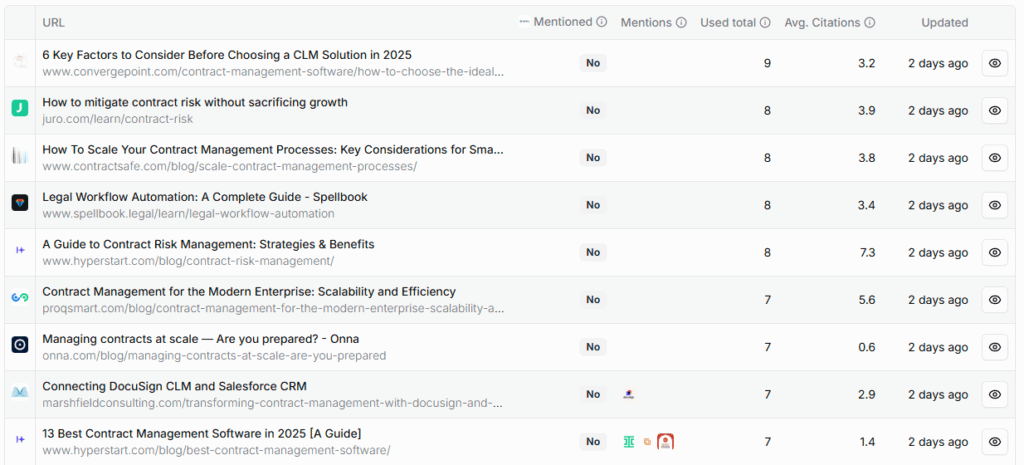
Using Peec we are able to analyse citations and sources - the content that is influencing the answers tools like ChatGPT may give users.

Here is an example from one of the prompts relating to the contract lifecycle management software example above, showing the specific URLs the various models have cited and how frequently:

AI visibility analytics dashboard
Source: Peec AI

As we specialise in B2B software, we often see sources like Gartner Magic Quadrants, Forrester Wave reports, LinkedIn Pulse, G2 and Capterra reviews and niche forums like Quora or Reddit being referenced by LLMs. If you would like to know more about how these sources might be influencing your own AI SEO visibility, get in touch.

5. Create a Prompt Aligned Content Strategy

Aligning content with your prompt matrix and based on your influence intelligence is worthy of its own post that would be thousands of words long, so we're not going to go deep into the process here.

In the GEO era, the most effective content is shaped by the actual language and context your buyers use when interacting with AI assistants. So here are a few things to think about for now:

  • Stay niche and really break down content by ICP, persona and buyer stage - journey context is key
  • Don't just mirror the prompt - answer the users intent with scannable, citable, contextual content
  • Think about how content can be easily parsed and summarised by LLMs and if summaries, clear headers, lists and schema markup might help
  • Focus on semantic richness over keyword stuffing
  • Ensure content remains fresh and up to date with your own citations and references
  • Think about your offsite content strategy and where content could be republished

6. Define an Offsite Strategy

Our research has shown that, for certain types of prompt at certain buyer journey stages, LLMs often prefer third party citations over your own site's content. This is one of the most large and complex areas of a generative engine or AI search optimisation strategy.

Branded mentions in locations beyond your own website are a factor we're tracking carefully.

So some areas to think about might include:

  • G2, Capterra, TrustRadius - high-quality reviews and clear positioning
  • Reddit, Quora, LinkedIn Pulse - authentic content and commentary
  • Analyst reports from Gartner and Forrester
  • Integration directories, analyst blogs, product roundups

Tactics:

  • Review campaigns on trusted platforms
  • Create content for third party guest publications
  • Comment and contribute to the discussion where LLMs learn in places like Reddit and Quora
  • Think about content republishing and repurposing, and if it makes sense to build authority in other places beyond your own website

5. Monitor Visibility Continuously

GEO isn’t static and models are updating regularly. Prompt phrasing shifts. Citations change. And monitoring visibility is therefore both more complex and more important than in the old school days of SEO, when Google was really the only search engine you had to worry about.

You need ongoing visibility monitoring to:

  • Track how often your brand is showing up for your selected prompts
  • See which models favour your content
  • Spot shifts in competitors’ inclusion rates
  • Identify which content or source changes lead to visibility changes

7. Don’t Abandon SEO Fundamentals

This isn’t a binary choice between SEO and GEO. In lots of our research we see positive correlation between brands with historically good SEO also performing well in AI search.

But hopefully it's also clear from our post that there are lots of new things to think about and some mindset shifts that need to happen in the new era of AI search and generative engine optimisation. Maybe it's time to build the business case to invest in AI SEO.

One important note: OpenAI has a partnership with Bing through it's relationship with Microsoft - meaning when a ChatGPT prompt triggers a web search, it relies on Bing's index. So whilst your previous SEO strategy might have only focused on Google, it may be worth thinking about how your site is indexed in Bing too.

If you're a B2B software brand looking for help understanding the shifting landscape of SEO and AI search, we would love to talk.

Ben Carter

July 5, 2025

Generative Engine Optimisation

What really is a GEO / AI SEO Agency?

But what really is a generative engine optimisation or AI SEO agency? Is it really any different to a standard SEO agency?

LLMO. AIO. AI SEO. GEO.

The buzzword soup around 'AI search' is growing by the day, and lots of it is noise. So many acronyms... all describing the same thing?

At FirstMotion, our definition of a Generative Engine Optimisation agency is currently:

A GEO agency (Generative Engine Optimisation agency) helps brands become

  • Visible in generative search tools like ChatGPT, Perplexity, Gemini and Claude
  • Credible across trusted third party sources that LLMs rely on
  • Influential at key moments in the AI-native buyer journey

Why is it called GEO?

We like the term Generative Engine Optimisation because we feel it puts a strong lens on visibility + context being at the centre of the strategy, whilst feeling like a natural next iteration of SEO.

As the new category of GEO and AI search optimisation evolves, we expect to see multiple terms still being used to talk about a brands AI search visibility and performance.

Is it it really different from 'normal SEO'?

In much of our research so far, there are some areas of correlation between 'traditional SEO' performance and GEO performance, but also many areas where there is much less overlap. We've seen some brands with what may be considered strong SEO performance metrics perform much worse in AI search results than we might expect, and been able to identify how some underdogs are punching above their weight in AI search.

Another important consideration is just how many different AI search engines there actually are, When we talk about SEO, we really only mean Google usually. But when we talk about GEO, the list of tools is extensive and they're all releasing new features at enormous pace.

Lastly, with SEO the process of 'keyword research' is fairly straightforward. There are no shortage of tools that will tell you how many monthly searches a certain keyword query will get. But with GEO, this same data doesn't exist. Prompts are much more contextual than keywords, much longer and much more personalised. Which is why at FirstMotion, our ContextualJourney™ technology platform sits at the heart of our process, using millions of B2B buyer data points, intent data and data enrichment along with AI to power some very deep audience intelligence. It's our firm belief that in a keyword-less world, you can't nail an AI search strategy without this.

Marketers are having to go through a big shift in mindset from 'rankings' to 'probabilities'.

So yes, some of the 'tactics' a GEO agency might use will often overlap with those we have used in SEO  for a long time. But there are plenty of differences needing a change in approach, mindset and lots of smart technology.

Rethinking the agency model

Part of building a B2B GEO agency proposition at FirstMotion is also about rethinking what brands really need and want from their agency relationships.

We're building FirstMotion as a new breed of consultancy rather than agency - faster, smarter, more technology, fewer layers of inefficiency, deeper B2B specialism - and therefore better value - than any search agency that has come before us.

A proper GEO partner should help you:

  • Understand your audience’s real AI search behaviour
  • Map prompts across your buyer journey
  • Optimise your presence on third party platforms LLMs trust
  • Create citability ready content, both on-site and off
  • Run regular visibility audits across tools like ChatGPT, Perplexity, and Claude
  • Shift your attribution thinking - because not all influence leaves a trail

Check out our FAQs page for your questions answered on GEO and AI search.

Alex Price

July 4, 2025

Generative Engine Optimisation

The GEO Glossary: key terms B2B marketers should know about AI search optimisation

Trying to get your head around the new world of AI search and generative engine optimisation? Our glossary is here to help.

If you’re still talking about keywords, rankings and SERPs, it's time to catch up.

Generative Engine Optimisation (GEO) is reshaping how B2B buyers discover, compare, and decide - the next phase of AI SEO.

We've put this glossary together to help B2B marketers get their head around all the AI search optimisation lingo they need to know.

These are the terms that matter now, in a world where prompts replace queries, AI assistants replace search engines, and visibility doesn’t always equal traffic.

Let’s get fluent.

Foundational concepts of GEO

TermWhat It Means
GEO (Generative Engine Optimisation)The practice of making your brand visible inside generative engines like ChatGPT, Perplexity, and Claude. Think SEO, but for AI tools or LLMs.
LLMO (Large Language Model Optimisation)A subset of GEO focused on influencing the output of LLMs directly, but often used interchangeably with GEO.
Answer Engine OptimisationStructuring website content to directly answer user queries within search engines and AI-powered tools - also used interchangeably with GEO / LLMO.
AI SearchSearch experiences powered by large language model, often conversational and generative, not link-based.
PromptThe new search query or keyword. It's what a buyer types into ChatGPT or Perplexity. Google research shows often 2-3x longer than a typical Google search.
Prompt VisibilityYour brand’s likelihood of showing up in a generative response to a specific prompt.
PromptPath™A FirstMotion framework for defining an GEO or AI Search optimisation strategy in AI-native B2B buyer journeys.
ContextualJourney™FirstMotion's own technology platform for AI search intelligence, including audience research, data enrichment & AI to define winning AI search strategies.

How AI models work when it comes to search

TermWhat It Means
LLM (Large Language Model)AI trained on massive datasets to generate human like text and answer complex questions.
Training DataThe information used to train a model before it's deployed. This includes web pages, forums, docs, YouTube videos etc.
CitationsThe sources an AI model references in its answers. Sometimes clickable/linked to, sometimes not.
Retrieval Augmented Generation (RAG)A method where LLMs pull in real time or external data to improve responses.
TemperatureA setting that controls how “random” or “creative” a model’s output is.
MemoryThe model’s ability to remember context across sessions - crucial for longer B2B journeys.

Generative Engine Optimisation techniques & tactics

TermWhat It Means
Structured ContentContent formatted for clarity and semantic cues - more digestible by LLMs.
Third Party OptimisationEnsuring your brand is visible on sources LLMs love to cite (G2, Forrester, Gartner, Reddit, LinkedIn etc).
Prompt MiningResearching and mapping the kinds of prompts your buyers are likely using.
Content MappingCrafting content to align with common prompts and maximise citation potential.
AI CitabilityHow likely your content is to be referenced by an LLM, based on structure, authority, and clarity.
Zero Click JourneyA buying process that happens entirely within an AI assistant, with no site visit at all.
LLMs.txtAn llms.txt file is a proposed standard for websites to guide Large Language Models (LLMs) in understanding and navigating site content.
Influence IntelligenceFirstMotion's approach to understanding why certain AI models choose to cite certain sources of 'influence' in their answers.

Challenges & limitations

TermWhat It Means
Dark Funnel 2.0Buyers discover and evaluate your brand via LLMs - but you never see it in analytics. See our recent blog post here.
Attribution CollapseThe breakdown of traditional attribution models in the face of AI discovery.
Visibility ≠ TrafficJust because you’re mentioned doesn’t mean they click - or that you can track it.
Answer TheftWhen your content trains or informs an LLM’s response - but you don’t get the credit or link.

Bonus: some SEO terms you should rethink...

TermWhy It’s Outdated
KeywordsLLMs don’t think in keywords, they understand context, concepts, and prompts. Prompts are much longer than keywords.
SERP rankingsThere’s not really a '1st position' in generative search, as every prompt can produce a different outcome for different users.
Traffic = SuccessInfluence matters more than clicks. Some of your most valuable B2B buyer touch points won’t show up in Google Analytics.
SEO-firstWe don't believe SEO is dead - but GEO is the long game.

Check out our FAQs page for your questions answered on GEO and AI search.

Ben Carter

July 2, 2025

Generative Engine Optimisation

Why Generative Engine Optimisation isn't about rankings - it's about probabilities

The shift from SEO to GEO or AI Search Optimisation needs a mindset shift for B2B marketers - the new world of AI search is no longer about rankings.

Let’s cut straight to it: if you’re still chasing 'position one', there's a chance you might be left behind.

GEO - Generative Engine Optimisation - doesn’t care about rankings. Because whilst AI tools like ChatGPT might make recommendations in a certain order, rankings in the traditional SEO sense don't really exist any more.

B2B marketers need to shift mindset - from rankings to probabilities - as the rise of AI search engines takes place.

The old world of SEO: deterministic, trackable, predictable

Traditional SEO was a closed circuit.

You targeted a keyword.
You optimised a page.
Google showed ten blue links in a fixed order.
Your goal: get to position one and stay there.

The whole ecosystem - from Ahrefs to Semrush to every SEO agency on the planet - was built around rankings as the metric of visibility. You could track them. You could report on them. You could screenshot your client’s “#2 position” and pat yourself on the back.

That world has changed.

The new reality: GEO is probabilistic

Generative search doesn’t serve up fixed, repeatable, consistent results.

It generates answers in real time - often different answers for different people, or even different ones for the same person, depending on context, model memory, and randomness.

You might have noticed that the more you engage with ChatGPT, the more it remembers. That's because it has a memory function.

Ask ChatGPT:

What are the top alternatives to Salesforce for a 500-person SaaS company?

Then ask Perplexity.
Then Claude.
Then Microsoft Copilot.
You’ll probably get different answers. Different vendors. Different justifications.
Sometimes links. Sometimes none. Sometimes citations (often very different citations depending on the LLM). Sometimes even hallucinations.

The results are not necessarily ranked, even if they are presented to you in a certain order.

They’re composed by models with constantly shifting training data and context sensitivity.

So what are you really optimising for?

You’re optimising for the probability of inclusion.

One prompt ≠ one output

In the world of SEO, there was broadly one search results page per keyword. OK, maybe it would change a bit depending on location or device (such as mobile) for certain search terms - but usually the ranking results would be consistent.

In GEO, the permutations are much wider:

  • The exact prompt wording changes the outcome
  • The user’s history/AI memory can influence the result
  • The model’s “temperature” setting (i.e. randomness) affects what it says
  • Forms of Retrieval Augmented Generation (RAG) pulls in live info - or doesn’t
  • Plugins, web access, or third party integrations may further skew results

Every prompt is a dice roll.

Every answer is a composition.

Every mention of your brand is a probabilistic event, not a deterministic position.

Why AI visibility monitoring is key

In the old world, you checked your keyword rankings once a week or received an email alert from your rank tracker.

In GEO, things are dynamic in that models are retrained, updated, tuned regularly and at increasing pace.

And diverse, because there are so many AI tools currently being used (ChatGPT, Claude, Gemini, Perplexity, Slack copilots, custom GPTs etc etc).

And many of these tools now include memory.

That means if a buyer asked about CRM platforms three weeks ago, looked at some options and gave some feedback, ChatGPT might remember it and suggest different follow ups depending on that prior context. It might know about the buyer, their purchase history, current tools, preferences and more.

So if you’re not monitoring visibility constantly, across multiple tools, across multiple prompts, you are flying blind.

This is why platforms like Peec, our analytics partner at FirstMotion, are starting to emerge. And why we believe ongoing visibility auditing will become as fundamental as technical SEO audits used to be.

But you can still influence how AI tools decide to talk about

Here’s the good news: while you can’t force an LLM to list your brand, in the same way you couldn't force Google to, you can increase the probability that it does.

How?

  • Third-Party Influence: Make sure you’re highly rated and well described on sites LLMs trust (G2, Capterra, Reddit, LinkedIn, Gartner, etc.)
  • Structured, Citable Content: Use clear headers, concise answers, and semantic structure that models can extract easily
  • Deep Audience Intelligence: It's fundamental to understand your buyers, their pain points, drivers, goals, buying triggers etc - otherwise effective prompt mining isn't possible
  • Prompt Based Content Planning: Build content for prompts, not just keywords. Think: “How do I evaluate XYZ tools?” or “What should I ask a vendor in a demo?”
  • Frameworks like PromptPath™: Map prompts across your buyer journey and shape visibility at every stage
  • Ongoing Visibility Audits: GEO is not a one and done exercise - it’s a system you need to operate continuously

If you're looking for a generative engine or AI search agency to help you understand how your B2B software brand is currently visible alongside competitors in tools like ChatGPT currently, get in touch.

Tom Batting

July 2, 2025

Generative Engine Optimisation

How AI search is making the B2B dark funnel even darker

There’s a new villain in the B2B dark funnel. Are AI tools like ChatGPT making attribution modelling even harder?

There’s a new villain in the B2B dark funnel.
It’s not Slack.
It’s not peers DMing on a LinkedIn.
It’s not some analyst behind a paywall.

It’s ChatGPT.

And it might be recommending your software right now…
Without a single link.
Without attribution.
Without any signal hitting your analytics.

What was the original dark funnel?

This one’s worse.

The old dark funnel was made of whispers.
Buyers talked in private Slack groups. They asked peers. They read analyst reports.
It was messy, but at least we understood the shape of it.

Now?
They’re typing prompts into LLMs.

And those prompts are replacing Google.
Replacing “best of” lists.
Replacing TOFU content.
Replacing your beautifully optimised case study that no one is clicking anymore.

And what do they get back?

A list of tools.
Some summaries.
A few alternatives.
And ideally: your brand name.

But not always a link and therefore no click. No source. No attribution.

You’re in the conversation.
You’re influencing the buyer.
But maybe you're not capturing it.

AI search has become the ultimate dark funnel

Let’s break it down:

  • A buyer asks ChatGPT:
    “What are the top onboarding tools for B2B SaaS?”
  • It replies:
    “Products like Appcues, Userpilot, Pendo and WalkMe are commonly used…”

No links. No clicks. No tracking.
Just a brand name floating in a black box.

Here's an example - not a link in sight.

ChatGPT Example

So is Google / Organic Traffic taking the glory for AI native discovery moments?

If the user decides to search for you later, the visit might show up as “Direct” if they somehow make it to your site by themselves or “Organic” in your reports if they come via Google. But if tools like ChatGPT aren't providing direct links to your site, then your content team gets no credit. Your paid team gets no insight. And your attribution is even more broken than you thought.

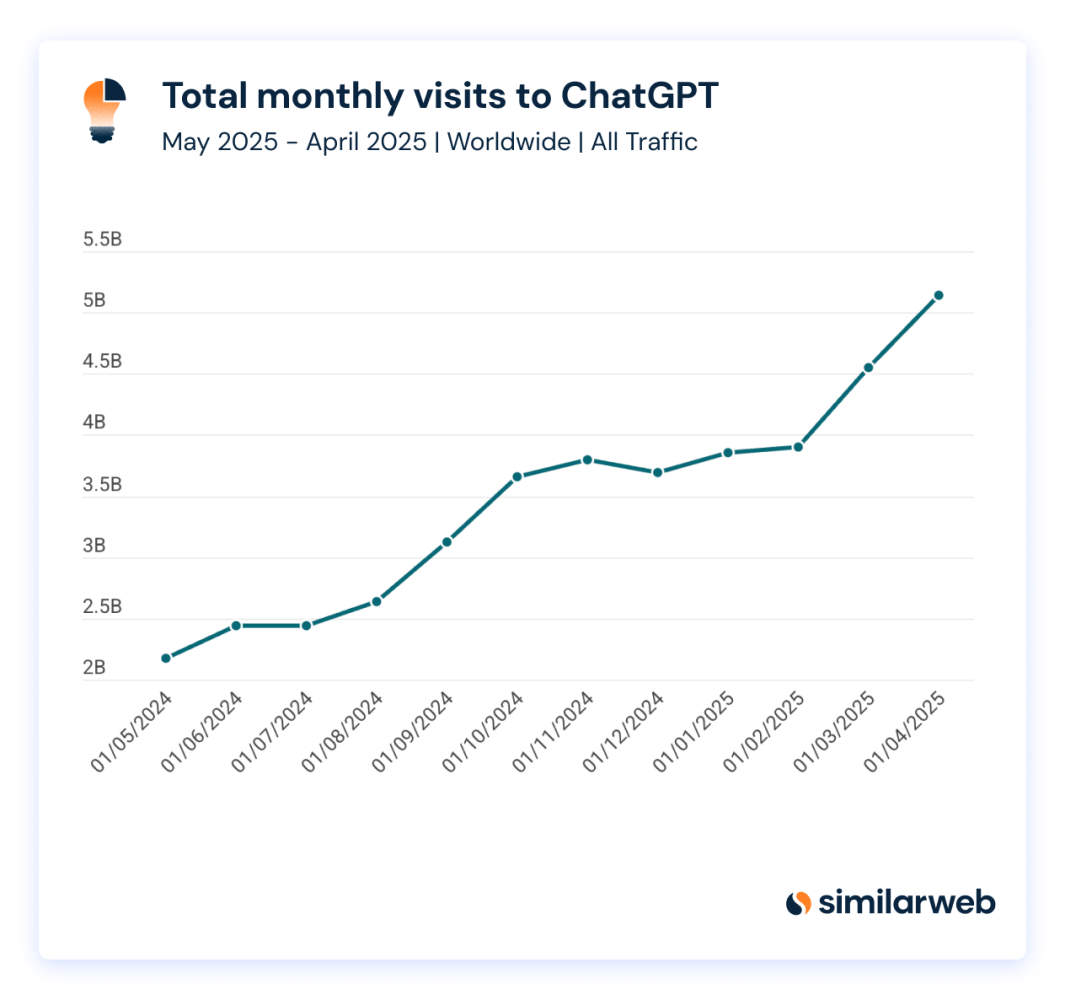
It's clear that adoption of AI tools like ChatGPT is on the rise, and that use of 'traditional' Google searches is falling. AI assistants are now buyer enablement co-pilots supporting the length of the B2B buyer journey, and they are trusted by buyers as sources of truth.

What’s HappeningWhy It’s a Problem
You’re getting mentioned in AI search responsesBut often with no click or traceable visit
Buyers are discovering you through promptsBut you have no way of knowing when or why
You’re influencing considerationBut your CRM, GA, and attribution tools don’t show it
Your “Direct” traffic is risingBut no one can explain why
Your 'Organic' might look like it's staying the sameBut it might be lying to you

So what do you do?

You fight back. Smartly.

  1. Audit Your Prompt Visibility
    Use AI tools like Peec to find out if and where you're showing up in AI responses.
  2. Optimise for LLMs, Not Just Google
    Structure your content so it’s prompt friendly – clear answers, concise summaries, comparative content, semantic markup.
  3. Track Branded Search as a Proxy
    Start mapping when your branded search spikes after known prompt exposure - it’s not perfect, but it’s something.
  4. Double Down on Name Recall
    If the link’s not coming, your name needs to stick. Make sure you’re the tool they remember (and spell correctly) when they leave ChatGPT.
  5. Rethink Attribution Entirely
    The buyer journey is nonlinear and AI-assisted now. Build models that reflect influence, not just clicks.

If you’re not actively managing how your brand shows up in generative search - and understanding that visibility ≠ attribution then you’re flying blind - maybe now is the time to start building the business case for investing in AI search.

Want to see if your brand is already showing up in AI search? We can tell you.

Alex Price

July 1, 2025

Generative Engine Optimisation

Why a16z is betting on GEO, and what it means for B2B marketers

When the world's most influential VC investor speaks, we all listen. Andreessen Horowitz (a16z) recently shared their take on the future of GEO.

When the most powerful VC firm in tech says Generative Engine Optimisation (GEO) is overtaking SEO, marketers should pay attention. A16Z’s recent piece titled 'How Generative Engine Optimization (GEO) Rewrites the Rules of Search' confirms many of own thoughts: AI search is not just a trend, it’s a fundamental shift in how discovery works.

a16z Doesn’t Bet on Fads

Andreessen Horowitz doesn’t waste time writing trend pieces. When they publish a 2,000 word piece exploring GEO eclipsing SEO, it signals a seismic shift. These are the same people who spotted the mobile wave, backed Facebook before it had a revenue model, and invested early in Coinbase while regulators were still catching up.

Now they’re betting on Generative Engine Optimisation. Not as a side channel or speculative bet but as the next foundational layer of digital discovery.

GEO: What It Means and Why It’s Bigger Than You Think

GEO isn’t a buzzword. It’s about becoming discoverable, influential and quotable inside large language model (LLM) environments like ChatGPT, Claude, Perplexity, and Google AI Overviews.

After all, that's where many B2B buyer journeys are now beginning.

Unlike SEO, which optimises for rank, GEO optimises for answers. It’s conversational, context rich, and increasingly personalised. Models don’t care about who paid for the keyword, they care about giving their users the most specific, structured, trustworthy information.

GEO Is Driving Conversions

Is ChatGPT already an attributable chaannel responsible for driving pipeline? It appears so.

Buried in the A16Z post is a stat that should make every growth leader sit up straight: 10% of Vercel signups now originate from ChatGPT recommendations.

Vercel's CEO shared that just a month prior, that number was only 4.8%.

https://twitter.com/rauchg/status/1910093634445422639?ref_src=twsrc%5Etfw%7Ctwcamp%5Etweetembed%7Ctwterm%5E1910093634445422639%7Ctwgr%5E40565b78de75b32c20bb3b1126e022ba035aff22%7Ctwcon%5Es1_&ref_url=https%3A%2F%2Fa16z.com%2Fgeo-over-seo%2F

Our view at FirstMotion is that AI tools are not just search and discovery tools. They are buyer enablement co-pilots that sit in the decision making unit and support B2B buyers from start to finish - searching and discovery sure. But also comparing, evaluating, interrogating, analysing, negotiating - any pretty much everything else that happens in a B2B buyer journey.

Here's another example:

https://twitter.com/marc_louvion/status/1929157995327529122

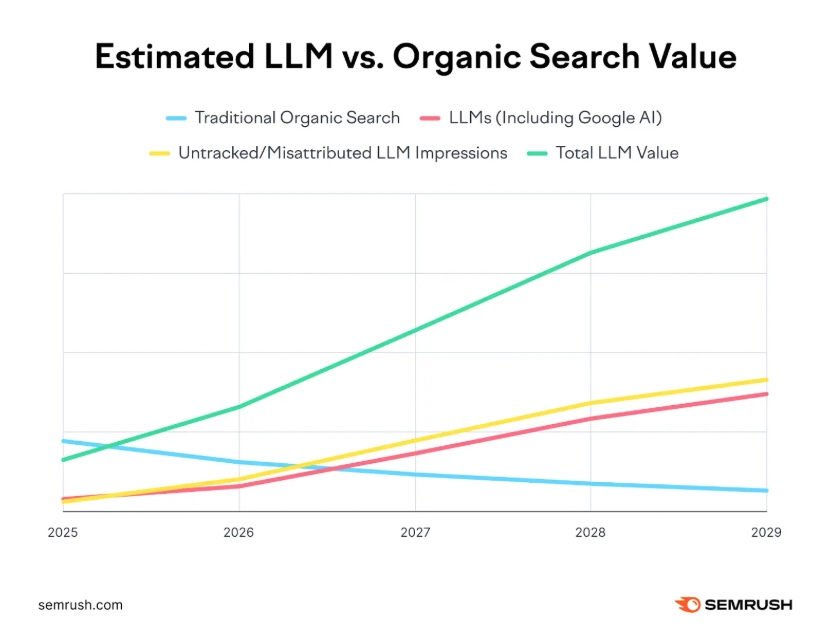
And a nice piece of data from a SEMRush AI Search Traffic Study,

We have seen that the average AI search visitor (tracked to a non-Google search source like ChatGPT) is 4.4 times as valuable as the average visit from traditional organic search, based on conversion rate.
LLM vs organic search traffic
Source: Semrush

From SEO to GEO

It's pretty clear the change is already here. Certain niches and industries may be impacted by others, but the data is evident - AI search poses both a big change, and a big opportunity (for those with a plan).

We're heading for a world where buyers aren’t browsing your homepage  - they’re prompting their assistant.

They’re not looking for your CTA. They’re looking for the best answer.

And if you’re not in the model’s context window, you’re not part of the decision.

GEO is no longer optional. It’s the front line of:

  • Buyer research
  • Product comparison
  • Objection handling
  • Feature comparisons
  • Demo prep
  • Onboarding planning
  • Negotiation

And more...

Strategic Steps for B2B Teams

So what now? Here’s how to get ahead:

  1. Audit your AI search visibility: Prompt tools like ChatGPT, Perplexity and Claude. Are you mentioned? Which of your competitors are winning? Why?
  2. Map prompts to the buyer journey - What are buyers doing at each stage? We use data enrichment & lots of AI to supercharge this process.
  3. Turn those into prompt informed content briefs - map content, spot the gaps, and understand where certain prompts might be falling short.
  4. Optimise - from here, the plan really depends on what the data tells us. There's no one size fits all, LLMs all work differently, each category is different and the pace of change is rapid.

Or, get in touch with us at FirstMotion, where it's our job to help B2B software marketing leaders navigate this period of change with clarify and confidence.

Tom Batting

June 27, 2025

Generative Engine Optimisation

Reddit: a critical part of an AI search visibility strategy?

A deep dive into how B2B legaltech companies are driving AI search visibility thanks to Reddit.

Reddit isn't just for memes.

Did you know there is a subreddit on Reddit called LegalTech? It has ~10,000 members, and describes itself as being for 'those in the legal field interested in improving the legal profession through the use of technology'.

Recently at FirstMotion, we were doing some AI search optimisation strategy work for a B2B software brand in the 'contract lifecycle management' software category. Basically software that helps you manage contracts - either as an in house legal team, or in a law firm.

After lots of audience intelligence work, we developed our prompt map. One of those prompts that we established could be used towards the middle or end of a B2B buyer journey was a comparative analysis of two products in the space:

I'm comparing Ironclad and LinkSquares for legal contract automation – which is better? Who else should I consider?

For this prompt, ChatGPT used Reddit as the most frequently used source - being cited in 57% of chats relating to this prompt.

Thanks to our analytics tools, we can see the various Reddit discussions being cited by tools like ChatGPT and Perplexity when they are responding to users prompts:

Reddit influencing GTP
Source: Reddit

So if you thought Reddit was just for investing in meme coins - think again. There are very serious professional B2B buyers, like Jennifer, the General Counsel above, using Reddit in very niche communities which are extremely highly regarded by AI search tools.

Of course Reddit wasn't the only source - here are some of the others ChatGPT used:

Influence sources in ChatGPT
ChatGPT Sources: Peec AI

LegalTech is just one example. For B2B software companies in technical niches like developer tools, security, cloud etc - Reddit is likely to be even more active around these topics. Maybe it's a cliché, but it's still the case that more 'techy' buyer personas might be more likely to be spending time on Reddit.

Why is Reddit often cited by LLMs?

There’s a clear logic to why Reddit dominates:

  • Authenticity: The posts are written by real users in real situations.
  • Nuance: Reddit threads don’t just compare features - they surface gotchas, unfiltered opinions integration headaches and actual outcomes.
  • Freshness: Active threads are updated, revisited and built upon. LLMs prefer live ecosystems over static blog content.

Reddit’s chaotic, unfiltered nature is exactly what makes it valuable. It provides a context and depth that AI models crave.

Reddit is feeding LLMs - and brands are reacting

Recently, Reddit Chief Executive told the Financial Times “20 years of conversation about everything” and so it's no surprise that LLMs love Reddit.

Multiple advertising and agency executives speaking during this month’s Cannes advertising festival told the FT that brands were increasingly exploring hosting a business account and posting content on Reddit to boost the likelihood of their ads appearing in the responses of generative AI chatbots.

In 2024 Reddit and OpenAI announced a partnership - one of only a few examples of an AI company not just crawling the web and helping themselves to content, but actually investing in a properly licensed commercial relationship. This is a clear sign of how LLMs like ChatGPT value Reddit's content.

There's never been a better time for a B2B software brand to invest in a Reddit strategy.

Ben Carter

June 26, 2025

Generative Engine Optimisation

Is product documentation a gold mine for AI search optimisation & AI native B2B buyer journeys?

Could technical product information prove valuable in improving AI search optimisation visibility for B2B software companies?

AI assistants are part of the B2B decision making unit. They are buyer enablement co-pilots, supporting buyers from discovery through to contract negotiation.

When ChatGPT, Perplexity or Google AI Overviews answer technical purchase questions they reach past glossy top of funnel pages and often cite deep documentation and user generated content instead. Vendors with clean, structured, easily crawlable product docs could win a disproportionate share of these citations. Treating product/technical documentation as a marketing asset has sometimes been done by teams focusing on long tail SEO, and with great impact. But considering how it fits into large language model optimisation and a generative engine optimisation strategy could now be table stakes.

The AI Search Shift

Picture this: your CTO opens ChatGPT and types “Which Kubernetes platform offers native GitOps, SOC 2 compliance and a Terraform provider?”. In a few seconds the AI tool replies with a ranked shortlist, citations and integration caveats, all without a single Google click. Look at the footnotes or citations and you will see GitHub issues, vendor documentation and Stack Overflow threads outnumbering slick hero pages and keyword stuffed blog posts.

AI search tools are rewriting the visibility rulebook and an asset they prize that is particularly relevant to B2B software companies could well be deep, technically rich documentation that answers very contextual user queries.

How AI Assistants Cite Product Documentation

We know from our own client research at FirstMotion that often technical product documentation or marketplace integrations are picked up and used as a citation source by LLMs.

Take for example some research into the Contract Lifecycle Management software category we undertook recently.

For an evaluation stage prompt: which CLM solution integrates best with Salesforce, we saw Salesforce's own AppExchange being referred to as a source by ChatGPT:

AI influence citation sources
Data from Peec AI

And for a similar prompt: CLM software that integrates well with Microsoft 365 for in house legal teams

Microsoft's own 'Learn' documentation and 'AppSource' integrations marketplace are referenced as sources by ChatGPT:

Data from Peec AI

However, if you type these same prompts as searches into Google, these sources are much less visible on page 1 of the traditional results page - if visible at all.

The Rise of Deep Pages

So traditional Google search results are still often preferring to surface blog content, whereas LLMs are relying more heavily on deeper, technical documentation.

It seems to be that large language models slice across the entire URL tree, surfacing /docs/, /api/, /help/ and even changelog fragments when those paragraphs align with the user’s question. Google AI Overviews can perform similar deep linking, bypassing the homepage entirely. Shallow 'menu level' pillar pages, and sometimes even blog posts, simply do not contain the detail models need to answer certain user queries.

Technical Documentation as an AI Search Visibility Cheat Code

Structured product docs hit the sweet spot between semantic density and crawlability. They are written for developers, packed with explicit feature labels, and sprinkled with code snippets that double as context tokens. That makes them perfect fodder for retrieval augmented generation.

When a late‑stage buyer asks about tile rendering speed or GDPR compliance the model can quote the exact paragraph that answers it – and Mapbox wins a seat at the shortlist.

llms.txt – What, Why, How

llms.txt is a technical file that serves as a guide for large language models (LLMs), helping them efficiently discover and prioritise high value content on your site. Think of it as the inverse of robots.txt: rather than telling crawlers what to avoid, it actively tells them what to focus on.

For B2B software companies, this could include API references, integration guides, pricing breakdowns, SLAs, and security documentation. These pages are often buried in subfolders or gated behind obscure navigation paths, which means LLMs may miss them during general crawling. With llms.txt you create a clear index of evergreen, citation worthy content that LLMs can parse and embed into their knowledge. The practical benefits are twofold: it could increase the likelihood of being cited in AI generated responses, and it gives you control over the narrative touchpoints LLMs use when summarising your product.

Rethinking ‘noindex’

Some teams historically cloaked product or technical docs behind noindex for fear of SEO cannibalisation or spreading Google's crawler too thin. That reflex probably now belongs to a pre‑AI era. Today, blocking crawlers may not be as helpful, when the AI models themselves have the capability to consume much more data, and more easily understand what's relevant and what's not.

Conclusion – The Existential Risk of Staying Invisible

B2B buying is converging around conversational search and AI tools are now buyer enablers in AI native buyer journeys. If a model cannot cite you, you're missing an opportunity.

Ben Carter

June 25, 2025

Generative Engine Optimisation

G2.ai: the future of G2 in AI search & B2B buyer journeys

What do B2B marketers need to know about G2.ai, and the role marketplaces like G2 play in the future of AI native buyer journeys.

G2 has recently launched G2.ai, an "AI driven discovery" bolt on that sits awkwardly on top of its once dominant software marketplace. It promises faster conclusions, smarter suggestions and personalised shortlists. That all sounds lovely, until you remember one awkward fact: we can already get that - and more - from the AI assistants living in the tabs we keep open all day. G2 is trying to claim a piece of an AI search future that has already rushed past it.

The numbers do not lie: G2’s traffic is in retreat

Public traffic estimates from tools like Similarweb show G2’s monthly visits sliding. While the exact figures vary depending on the data source, the direction of travel is brutally clear: fewer people are actually using legacy reviews/comparison marketplaces to compare software.

Meanwhile Google - the gateway G2 still relies on for visibility and referral traffic - has started injecting AI Overviews directly into results. Ask a buying question like “best CRM for SMB” and you will increasingly see a generated answer that summaries multiple sources, pushes the organic listings halfway down the page and removes the need to click through. Every time that happens, G2 bleeds a little more search driven oxygen.

AI search tools have already eaten G2’s lunch (and data)

G2.ai frames itself as a revolutionary layer, but in reality it is feeding on the same corpus the wider AI world hoovered up months ago. Crawl restrictions were too little, too late. Every major model in market has already ingested millions of G2 reviews, comparison tables and category descriptions. Whether or not that wholesale scraping was ethical or legal is a fascinating legal sub plot - but it is has already happened, whether you like it or not.

The result is simple: when I ask ChatGPT, Claude or Perplexity for a software recommendation, they reply with a blended, perspective rich answer that references G2, Capterra, Gartner Magic Quadrants, Forrester Wave reports, analyst commentary and user forums. G2.ai can only echo one of those sources - itself.

Narrow data, narrow answers

G2.ai insists it provides a “trusted, expert” shortlist. Let us decode that in the context of AI search: it is a shortlist constrained by a single data silo. Even if you believe every G2 review is squeaky clean and free of vendor gaming (unlikely), the most it can offer is a statistical view of its own walled garden. The wider context - total cost of ownership analysis, integration pitfalls, regional support quality, roadmap credibility - lives outside G2’s perimeter, and therefore outside G2.ai’s reasoning.

Contrast that with your personal AI assistant of choice. It remembers the systems you have already ruled out, the tools you already use, the budget ceiling finance slammed on your last project, the tech stack your architects refuse to touch and even your colleague in IT security that doesn't want any more software tools. That context shapes the next recommendation instantly. G2.ai cannot do that because it does not know you, and because its creators are still dragging legacy review workflows into an age of conversational search.

A patch on a leaking hull

G2 is not the first incumbent to slap an AI sticker on its product in hope investors can breathe easier. The problem is deeper than branding. Marketplaces that rely on capturing search intent between keyword and vendor website are being disintermediated. AI search answers that intent directly and instantly, inside the viewport where the question was asked. Adding a chat search box on G2’s own site does nothing to reverse that macro shift.

G2.ai is, at best, an undersized plug jammed into the hole below the waterline. It might slow the flooding briefly. It will not pump the water back out, and it definitely will not stop the ocean creating new holes tomorrow.

What does it mean for B2B marketers?

G2 can still be a highly valuable source for visibility. But not for the reason that it used to be.

LLMs love training on review data from sites like G2. We know from lots of our own research that G2 often will be referenced by AI search tools like ChatGPT as an influential source for a B2B software search.

So the value of being on G2 is now that it indirectly plays into your AI search visibility strategy. A strong G2 profile may result in more likelihood of being referenced by a AI tool for a search relevant to your category. So it's still worth investing in your G2 presence - not for direct clicks and referrals, but to optimise for AI search (AEO, LLMO, AIO, GEO - whatever the process of optimising for visibility in AI search is actually called).

Final thought: An AI Band-Aid on a Sinking Ship

We are not writing G2’s obituary - yet. There is still a role for independent reviews of B2B software - but the landscape has changed massively. But for now, it seems G2 is trying to claim a piece of an AI search future that in many respects has already rushed past it.

Alex Price

June 25, 2025

Generative Engine Optimisation

Guide: Generative Engine Optimisation for B2B software & SaaS marketers in 2025

The B2B SaaS marketers guide to Generative Engine Optimisation (or AIO, LLMO, AEO). Is SEO dead, and what's the impact for B2B marketers?

AI Search, Generative Optimisation & The New Search Landscape

For years, many B2B buyer journeys have begun with a Google search. All the way back in 2015, what feels like a lifetime ago now, Google released research stating that 71% of B2B buyer journeys began with a Google search. They also shared that 89% of B2B researchers use the internet during the B2B research process. If you want an indication of just how much things have changed, Google has now deleted this research entirely and we had to use Wayback Machine to access it.

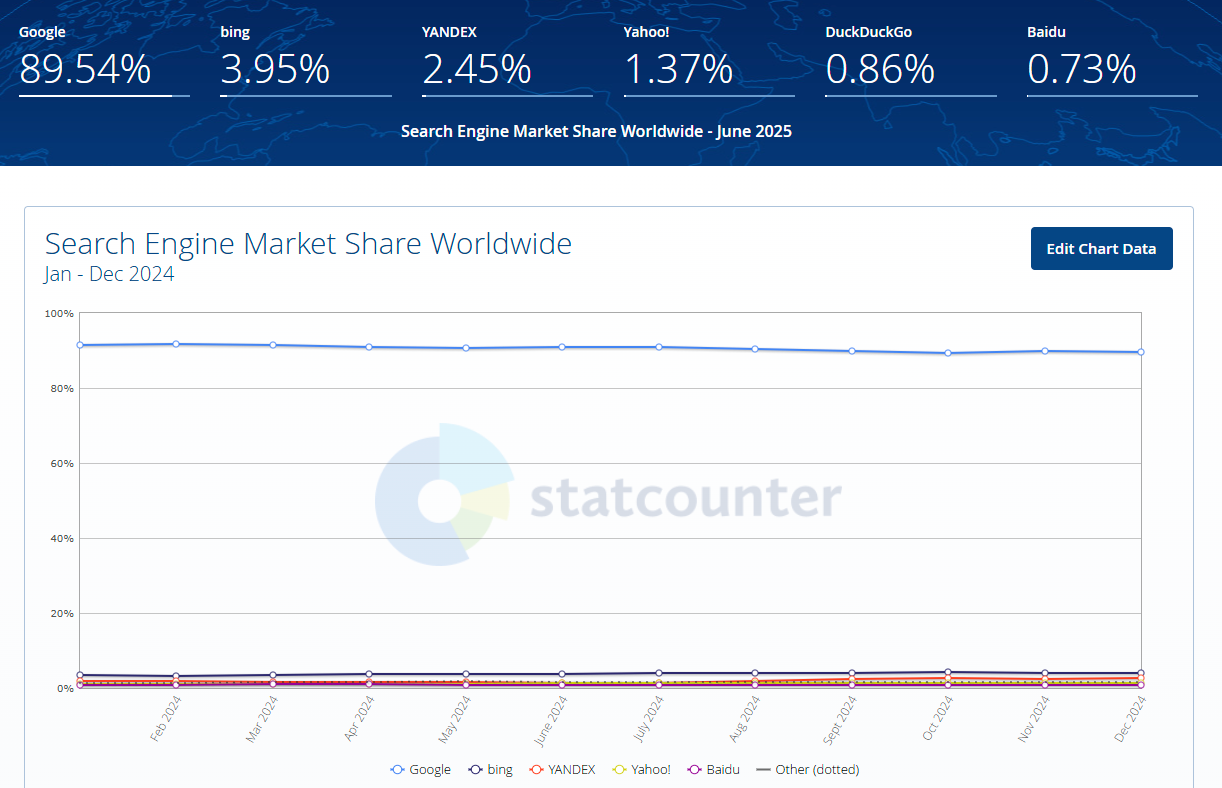
Fast forward 10 years, and it’s fair to say that we’re going through an enormous shift in terms of how B2B buyers discover solutions thanks to AI. There's lots of statistics showing the rise of AI search tools potentially undermining Google's dominance.

The days of optimising for SEO keywords and chasing rankings, clicks, and traffic are not completely behind us - but it's fair to say things are changing quickly.

AI tools like ChatGPT, Claude, Perplexity, and Google’s AI Overviews are in many respects the new web browser. They have become part of the B2B decision making unit. They sit alongside B2B buyers, acting as buyer enablement co-pilots across the entire length of the B2B buying journey - not just the initial search or discovery moment.

And so B2B marketers need to shift their mindset - unlike Google, AI assistants aren't just an acquisition channel. They are now trusted partners to B2B buyers as they discover, research, compare, procure and negotiate.

Across many clients and analytics sources, we’re seeing clicks and traffic from Google’s search results page falling, whilst referral traffic from AI tools begins to rise. In May 2025, Google announced AI Mode in the US market, giving users an option to turn off the traditional list of blue links known as the Search Results Page entirely - and instead use AI as default. It's clear that the rate of change is faster than even lots of SEO experts imagined.

You don’t have to look far to find many in the marketing and search world asking a big question: is this the end of clicks and traffic to websites

Is Buyer Search Behaviour Shifting from Google SERPs to AI Assistants?

At Google’s I/O 2025 event, they acknowledged that users are searching very differently in AI tools compared to the traditional search bar.

It appears a psychological value exchange has already been established. Users are searching much more deeply - on average providing 2-3 longer search queries in AI tools. In return, they are expecting deeper, more contextual, more personalised search results from AI tools.

A few years ago, a B2B buyer searching for a new marketing automation software might have begun their search with a Google of a term like ‘marketing automation software’:

Example Google search

But now, they are turning to tools like ChatGPT and providing much more information in their search. They know that if they provide more context, they will get better results.

Example ChatGPT prompt

AI search tools like ChatGPT, Claude, Perplexity, and Google’s AI Overviews are now acting as research co-pilots across the entire buyer journey – not just tools for initial discovery. These platforms are synthesising answers, recommending vendors, and shaping perceptions before a buyer ever lands on your website. And so it's fair to ask - are we heading for a future where websites aren't built for users - they are built for AI.

By 2028, brands’ organic search traffic will decrease by 50% or more as consumers embrace generative AI-powered search. Gartner

And so AI Search and a clear generative engine optimisation strategy has to be a priority for any B2B marketer. Clearly the traditional search results page is changing dramatically, along with buyer behaviour. And with it, B2B marketers must shift their strategy too.

What's the value of Generative Engine Optimisation (GEO)?

Optimising for AI search tools and GEO can drive success for B2B SaaS & software businesses across:

  • Authority in competitive, research led software categories
  • Speed across complex sales cycles by answering objections earlier
  • Conversion through prompt aligned content and message reinforcement
  • Revenue by generating higher quality leads from better aligned buyer journeys

Unlike traditional SEO content strategies, we focus on real business outcomes - visibility that leads to opportunity creation, not vanity metrics.

In this guide, we’ll unpack what GEO really means for B2B marketers, why it matters now, and how to approach it with a full funnel, pipeline first mindset.

We believe in a B2B marketing context, GEO is:

  • Prompt driven, not keyword driven
  • Built for LLMs, not legacy search engines
  • A process of buyer journey orchestration, not just a measure of brand visibility

It builds on some foundations of SEO and AIO, but expands into a full funnel, buyer centric model designed to convert attention into pipeline and optimise the entirety of AI-native B2B buyer journeys.

Why GEO Matters for B2B Marketers

Google itself is shaking up how it delivers results, despite being a business traditionally reliant on blue links and advertising revenue. Look how quickly AI Overviews are growing in visibility at the top of the search results page now:

Many B2B purchase journeys are long, complex, and deeply research led. They often involve:

  • Multiple decision makers
  • Large average contract values
  • Objection handling
  • Competitive comparisons

AI tools are becoming buyer enablement co-pilots - used not just for discovery, but for:

  • Comparing solutions
  • Surfacing objections
  • Exploring pricing models
  • Analysing trade offs
  • Running RFP processes
  • Negotiating terms

This creates an opportunity for B2B marketers to:

  • Reach buyers earlier in their journey
  • Actively shape category narratives
  • Build brand preference before outreach

We're also seeing that traffic and engagement from AI search can be higher converting. Why might referral traffic from AI tools like ChatGPT be more likely to convert than traffic from Google?

  • Lower competition in responses if your brand is visible
  • Higher buyer intent, carrying out deeper research
  • More specific, context aware buyers

The team at Seer Interactive shared a website that was seeing referral traffic from ChatGPT converting at 15.9% - compared to 1.76% from Google.

In short, GEO may help you meet buyers before your competitors do and convert them faster.

The Dark Funnel of AI Search

One of the biggest challenges for B2B marketers when it comes to AI search is analytics, attribution and tracking.

AI tools could well be making the so called 'dark funnel' even darker, because often AI tools might not include a link to a product they recommend.

How LLMs like ChatGPT 'Decide' What to Content to Show (B2B Software Context)

Generative engines don't really rank content in the same way search engines goo. They synthesise answers, pulling from a mix of structured and unstructured data to produce coherent, context aware outputs.

A. Third Party Signals and Data Sources

In B2B software, visibility is often influenced by brand mentions and references by sources like:

  • Review platforms like G2, Capterra, and TrustRadius
  • Analyst citations from firms like Gartner and Forrester (e.g. Magic Quadrant inclusion, Wave reports)
  • User generated content (UGC) on platforms like Reddit, Quora, Stack Overflow
  • Media coverage and backlinks from high authority publications or industry blogs

These sources signal authority and credibility, shaping what LLMs synthesise when responding to prompts like:

  • "Best procurement platforms for enterprise buyers"
  • "[Vendor A] vs [Vendor B] in 2025"

B. Your Brand’s Own Content and Website

However, your own site still plays a critical role in GEO. Generative engines can pull directly from your domain, especially when:

  • Content is well structured and answers specific, high intent prompts
  • Pages are cleanly tagged, with clear headers, lists, tables, and schema markup
  • You provide FAQs, comparisons, and product use cases that align to buyer intent
  • Your content is kept fresh, unique, and crawlable

Examples of content types that boost visibility in AI responses:

  • In depth solution pages answering niche buyer questions
  • Industry specific landing pages talking clearly to segmented ICPs or buyer personas
  • Comparison pages structured around real world decision making
  • Pricing breakdowns and total cost of ownership explainers
  • Customer success stories aligned to verticals or use cases

C. Technical Site Optimisation for GEO

Optimising your site for generative engine retrievability can have some similarities with traditional SEO, but here is an overview:

  • Structured data and schema markup to help LLMs extract and understand key facts, attributes, and comparisons
  • Clear content hierarchy and internal linking, enabling better semantic context
  • Use of tables, bullets, FAQs, and TL;DR summaries that are easily summarised or lifted into responses - content chunking
  • Sitemap and crawl accessibility, including proper robots.txt configuration
  • Deployment of a llms.txt file to signal AI access permissions (e.g. whether your content can be used for retrieval or training)
  • Ensuring AI crawlers can reach your site and aren't blocked by tools like Cloudflare

GEO vs SEO: What’s the Difference for B2B marketers?

SEOGEO
Keyword drivenPrompt driven
Google rankingsSynthesised answers
Traffic & CTRBuyer visibility & retrievability
TOFU focusedFull journey orchestration
On page SEO & backlinksEcosystem visibility & source alignment

What is a B2B specific GEO / AI Search strategy? Aligning Prompts to the B2B Buyer Journey

GEO isn’t just about ranking for "best software" prompts. It’s about shaping how your brand shows up across the entire B2B journey, and that begins with deeply understanding your audience, their needs and pain points:

Example Top of Funnel B2B buyer prompts:

  • "Best [category] platforms for [industry]"
  • "Best ways to automate [process] workflows"
  • “How do companies manage [challenge] effectively?”
  • “Alternatives to using spreadsheets for [process]”
  • “What software could help us improve [challenge]?”

Example Middle of Funnel B2B buyer prompts:

  • “[Vendor A] vs [Vendor B] vs [Vendor C] – which is best for a [type] business with [specific challenge]?”
  • “Best [specific software] for insurance companies”
  • “What key features should we look for in a [category] platform?”

Example Bottom of Funnel B2B buyer prompts:

  • “What are pricing tiers and contract terms for [Vendor A]”
  • “Does [Vendor A] integrate with [existing tool]?”
  • “What are red flags to watch out for when buying [solution]?”
  • "What contract terms should I look to negotiate for a [solution]?"

Each prompt is a chance to:

  • Build trust
  • Guide decisions
  • Pre handle objections
  • Accelerate pipeline velocity

And that's why we believe GEO is not just a visibility strategy - it’s a way of optimising the full length of the buyer journey in the new era of AI native buyer journeys.

Introducing the ContextualJourney™ Platform

At FirstMotion, we go beyond basic GEO. Our proprietary technology platform, ContextualJourney™, is designed for B2B software companies selling in complex, considered, competitive and often high value B2B sales journeys.

It includes:

  1. Audience Intelligence: we believe deep buyer understanding has to sit at the heart of a successful GEO strategy
  2. Prompt Mining: using lots of data enrichment, AI and billions of B2B buyer data points, we can mine prompts that B2B buyers might actually be using
  3. Content Mapping: Aligning prompts to buyer journey stages, and design narrative architecture
  4. And a number of other features: we're building lots of exciting functionality into our platform, redefining what the B2B SaaS AI SEO agency of the future looks like

We also use a number of other third party best in class analytics platforms for measuring brand visibility within AI tools.

Common Misconceptions About GEO & AI Search

As Generative Engine Optimisation becomes a more recognised term, it's important to address some of the common misunderstandings that can lead B2B marketers astray.

"It's just SEO for AI" - This is perhaps the most common misconception. While GEO borrows some ideas from SEO and there is certainly some overlap in terms of tactics, it requires a shift in both mindset and strategy. Generative engines are not search engines. They don’t display a list of links or necessarily operate on classic ranking signals. Instead, they synthesise answers and present a single authoritative response. GEO is about orchestrating visibility throughout the buyer journey - not just at the top of it.

"We just need more AI content" - Flooding your site with generic, AI generated content won’t make you visible inside LLMs. What matters is content that aligns with buyer intent and the prompts they’re using. GEO requires structured, high quality, contextual content that is both retrievable and referenced by trusted sources, based on deep audience intelligence.

"It's too early" - Buyers are already using AI tools to explore options, compare vendors, and evaluate pricing - often in ways that never touch your website. If you're not thinking about how to be visible in those journeys now, you're already behind.

If you’re a B2B marketing leader looking to drive real outcomes in the new era of AI native B2B buyer journeys, we think it's time to start thinking about a generative engine optimisation strategy.

Check out our GEO terms glossary if you're still trying to get your head around the space.

Ben Carter

June 12, 2025

Generative Engine Optimisation

What types of AI prompts should B2B software companies optimise for?

How should B2B software companies think about mapping AI prompts/searches onto their buyer journeys to optimise for LLM visibility?

Generative AI tools like ChatGPT, Claude, and Perplexity are fundamentally reshaping how B2B buyers research and evaluate B2B software vendors. Traditional keyword based search is no longer the only gateway to discovery. Increasingly, buyers are turning to AI assistants for answers to their most pressing questions - not just for initial top of funnel research, but across the entire modern AI assisted buyer journey.

So prompt visibility is becoming as important as search visibility has been for a long time. For B2B software companies, it’s not just about ranking on Google anymore. It’s about being the answer when a buyer types a high intent question into an LLM.

But what kinds of prompts should you actually be aiming to appear in? How do you know which ones matter across the buyer journey? And what can you do to make sure your brand is part of those conversations?

Why prompt visibility matters for B2B software marketers

Enterprise software buying journeys can be long, complex, and often involve multiple stakeholders across technical, commercial, and executive functions. These buyers aren’t typing “CRM software” into Google and clicking the first few links anymore. They’re asking AI tools nuanced questions like:

  • “What’s the best CRM for a fast-growing B2B sales team?”
  • “How does HubSpot compare to Salesforce for integrations?”
  • “What are the hidden costs of switching marketing automation tools?”

They might also include details of their company size, team size and other company information - B2B buyers know that the more information they provide in a search, the more contextual, personalised results they are likely to get back.

These prompts are replacing many of the early and mid stage searches that marketers used to target with blog content and SEO optimised landing pages. And because LLMs often return a smaller number of high confidence results compared to the traditional search results page, the cost of not appearing in those answers is growing.

Prompt visibility influences brand awareness, authority, and even conversion outcomes. It can shape a buyer’s shortlist before they ever visit your website.

The role of audience intelligence

To build an effective prompt strategy, you can’t just guess what buyers might be asking. You need a deep, structured understanding of your ideal customers: who they are, what they care about, and how they think and speak. What their pain points are

This is where audience intelligence becomes critical.

Different roles ask different questions. A CTO evaluating a data platform might focus on architecture and compliance. A RevOps lead might be interested in integrations, reporting, and ease of deployment. A procurement manager could be looking for value, contract flexibility, and proof of ROI.

That means your prompt strategy must be segmented and persona aware. The more granular your understanding of your ICPs (Ideal Customer Profiles), personas, pain points and use cases, the more accurately you can anticipate the prompts they’re putting into tools like ChatGPT.

At FirstMotion, we use our own audience intelligence technology platform, ContextualJourney™ to help us guide this work. With millions of B2B buyer data points, intent data, enrichment and AI integrations, it enables us to 'prompt mine' highly effectively as a generative engine optimisation agency.

Deep audience intelligence is the foundation for any generative optimisation or AI search visibility strategy.

Mapping prompts to the B2B buying journey

One of the most effective ways to plan your prompt targeting is to structure it around the B2B buying journey. This helps you ensure you're visible not just when someone is learning, but when they're evaluating, comparing and deciding.

At FirstMotion, we use a process that translates traditional SEO keyword research into prompt archetypes tailored to each stage of the funnel. Here's a simplified view:

Top of Funnel (Awareness & Exploration)

These prompts reflect early stage curiosity or problem awareness.

  • “What are the best tools for managing spend in a SaaS business?”
  • “Alternatives to [Vendor] for procurement software”
  • “How can marketing teams measure content ROI?”

Middle of Funnel (Consideration & Evaluation)

Here, buyers are starting to compare vendors and shortlist options.

  • “[Product] vs [competitor] comparison”
  • “Best [category] platforms for [sector] companies”
  • “Must have features in [category] software”

Bottom of Funnel (Decision Support & Objection Handling)

These prompts signal serious buying intent and final-stage decision support.

  • “Customer reviews of [product] for global teams”
  • “Common problems during [vendor] implementation”
  • “Is [tool] worth it for companies under 500 employees in [sector]?”

Each of these prompt types maps to a specific kind of buyer intent. There are more opportunities than ever to be present and to have some kind of influence.

Measuring prompt performance

Tracking prompt visibility is still in its early days, but it's evolving fast. We use a range of tools and data sources to help marketers measure which prompts they're showing up in, how frequently they're being mentioned across different LLMs, and how competitors are performing.

We recommend building a Prompt Map - a working database of high value prompts segmented by buyer stage and persona. Then, track where and how your brand appears, and use this insight to shape content creation, improve prompt conditioning, and even influence how your brand is described on third party sources. Peec AI is our preferred analytics and visibility platform.

Scoring prompt visibility is also a valuable way to demonstrate progress and ROI in an AI first go-to-market motion.

Prompt visibility isn’t just a technical challenge - it’s a strategic opportunity.

For B2B software companies, appearing in the right prompts means being present at the precise moments buyers are shaping their understanding of a category, evaluating vendors, or trying to make a final decision.

If you want to win in this new landscape, start with audience intelligence. Understand who your buyers are, what they ask, and how they think. Then, work systematically to translate those insights into a prompt strategy that ensures your brand is part of the conversation.

Tom Batting

June 12, 2025

 (edited)